
Carte de la Louisiane
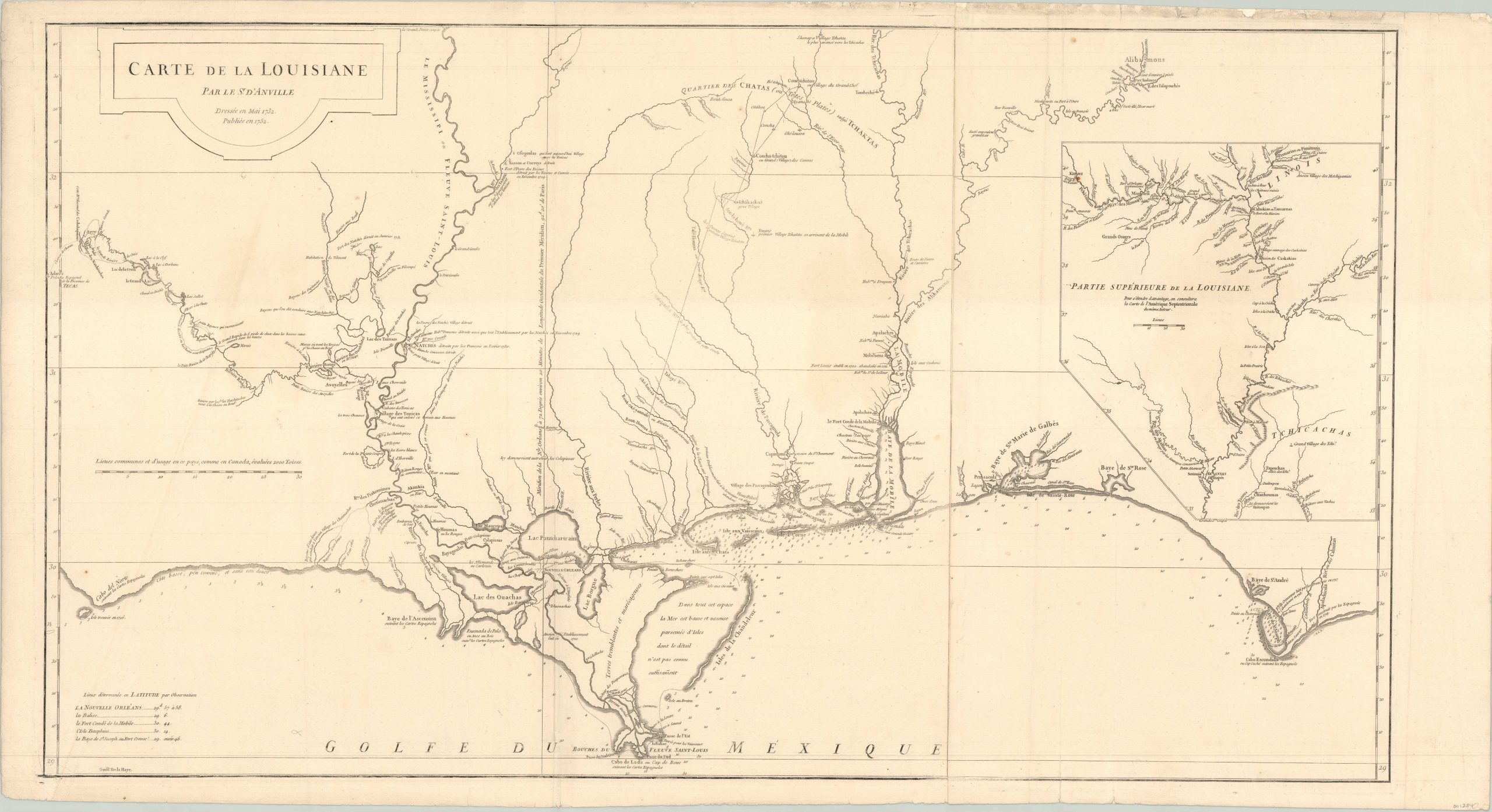
An early map of French colonial America along the Gulf Coast.
Out of stock
Description
This is an impressive French map covering the Gulf Coast between Cabo del Norte (Sabine Pass), Texas and the Apalachiola River in Florida; including portions of modern day Mississippi, Louisiana and Alabama. The image is roughly centered on New Orleans, founded by the French in 1718, and shows a large portion of their territorial claims in the mid-18th century.
Though the map was published in 1752, it was drawn roughly twenty years earlier and outlines the situation shortly after the Natchez Revolt. This attack on French inhabitants at Fort Rosalie by the local Native American Natchez tribe saw over 200 colonists killed, and resulted in the transfer of the Louisiana colony from the Company of the Indies to the French crown in 1731. Several references to the ongoing conflict are noted within the image, including the retaliatory destruction of the Grand Village of the Natchez.
Elsewhere on the map, the information presented is compiled from a variety of contemporary French sources and largely reflects the most accurate cartographic depiction of the region at the time. Depth soundings are meticulously shown along the coast, native villages can be seen dotting the banks of rivers, and an inset map shows the confluence of the Missouri and upper headwaters of the Mississippi River.
The map was created by Jean Baptiste Bourguignon d’Anville, one of the most influential cartographers of the 18th century and geographer to the King of France. d’Anville’s consideration for accurate sources, exhaustive research and meticulous calculations led him to revolutionize the industry of map-making; leading it on a path based more on scientific observation and careful study than speculation and geographic precedent.
Map Details
Publication Date: 1752
Author: Jean Baptiste Bourguignon d'Anville
Sheet Width (in): 40.20
Sheet Height (in): 21.60
Condition: A-
Condition Description: Creasing along fold lines and in a few extraneous locations. Small edge tears in the outer margin, and a small area along the top margin that has been reinforced (does not affect the image).
Out of stock