
The Shipwreck
$275.00
Illustrative fold out plates accompanying the third edition of William Falconer’s The Shipwreck.



Description
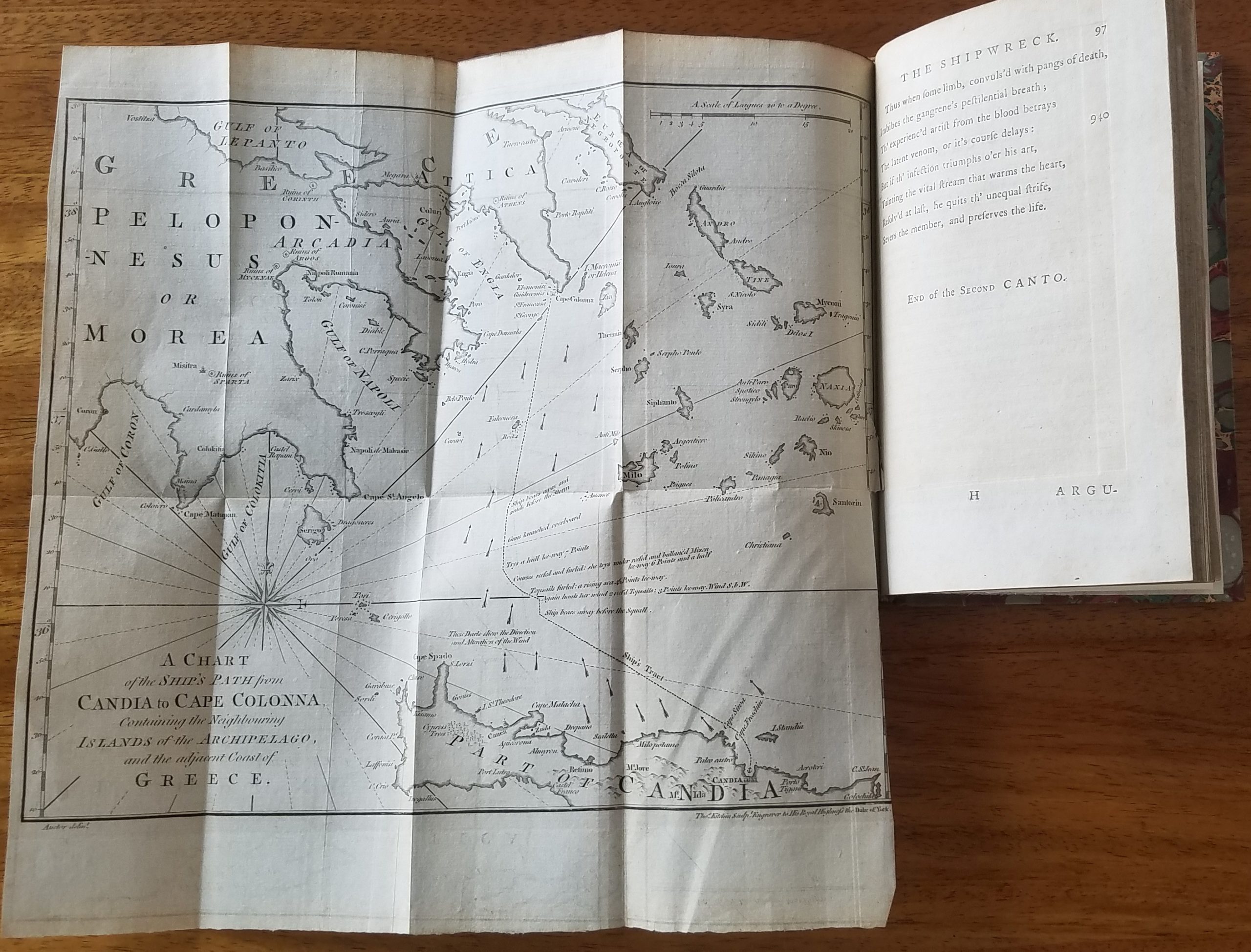
“A Chart of the Ship’s Path from Candia to Cape Colonna” – Unfolds to approximately 12.2″ x 12.6.” A detailed fold out map of the southern Greek archipelago and the northern part of Crete by Thomas Kitchin. The interior information provided relates directly to places visited by the protagonist of the ship Brittania throughout the course of the poem. The track of the ship as it traversed the region is also shown, along with notes representing important events along the way, including the ship’s last moments on the rocky coast of Attica.
“Elevation of a Merchant-Ship with all her Masts, Yards, Sales & Rigging” – Unfolds to approximately to 11.6″ x 14.6.” This diagram shows a full-rigged ship (three masts, square rigged) in profile, with individual components of the sails, rigging, blocks and tackle all labeled. Parts of the hull are also noted. The plate was included to provide reference to the audience about the construction and composition of the ship Brittania. Understanding nautical terms can be a challenge for landlubbers, and this helpful resource would have cut down on any confusion on the part of the readers.
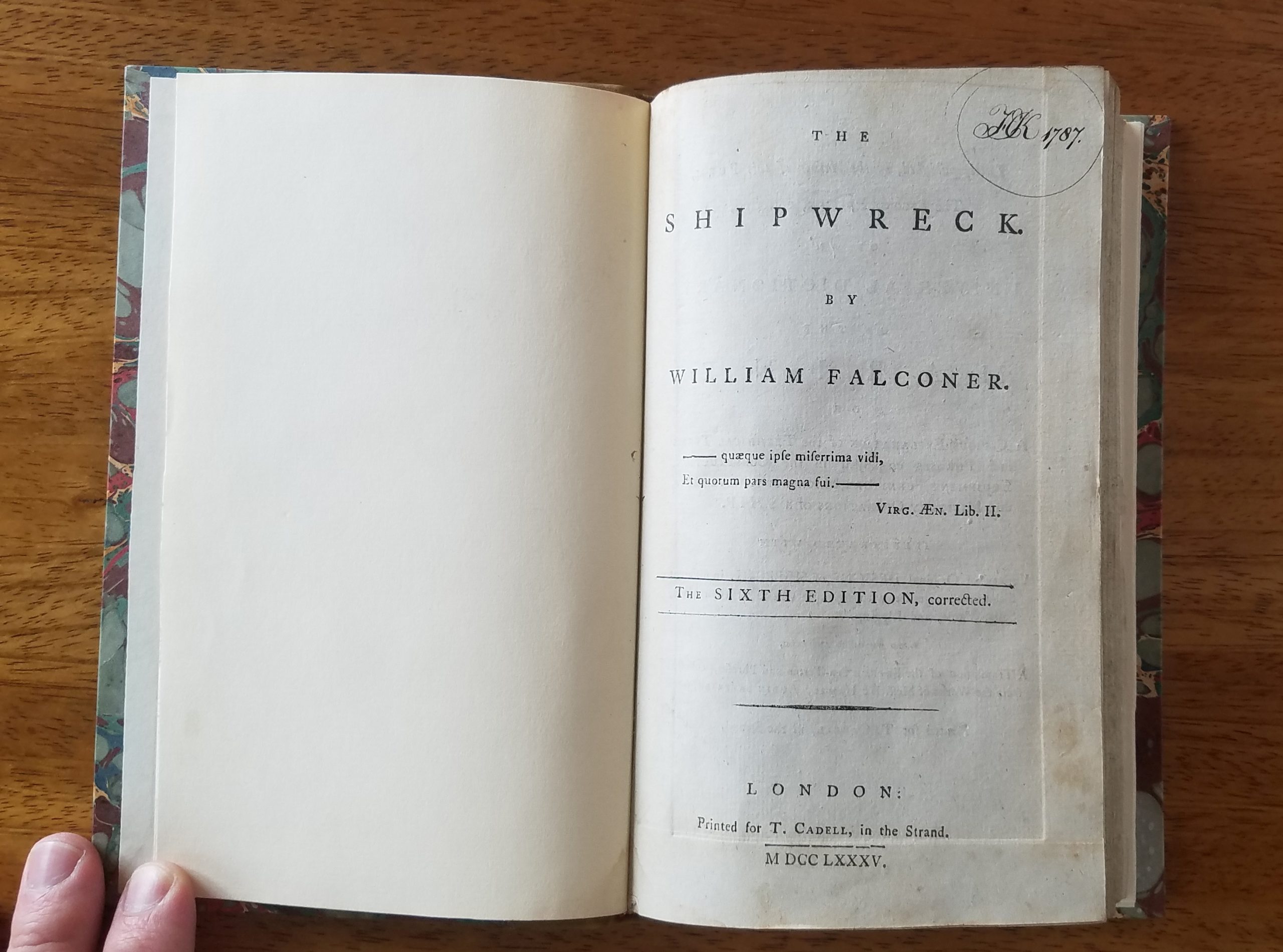
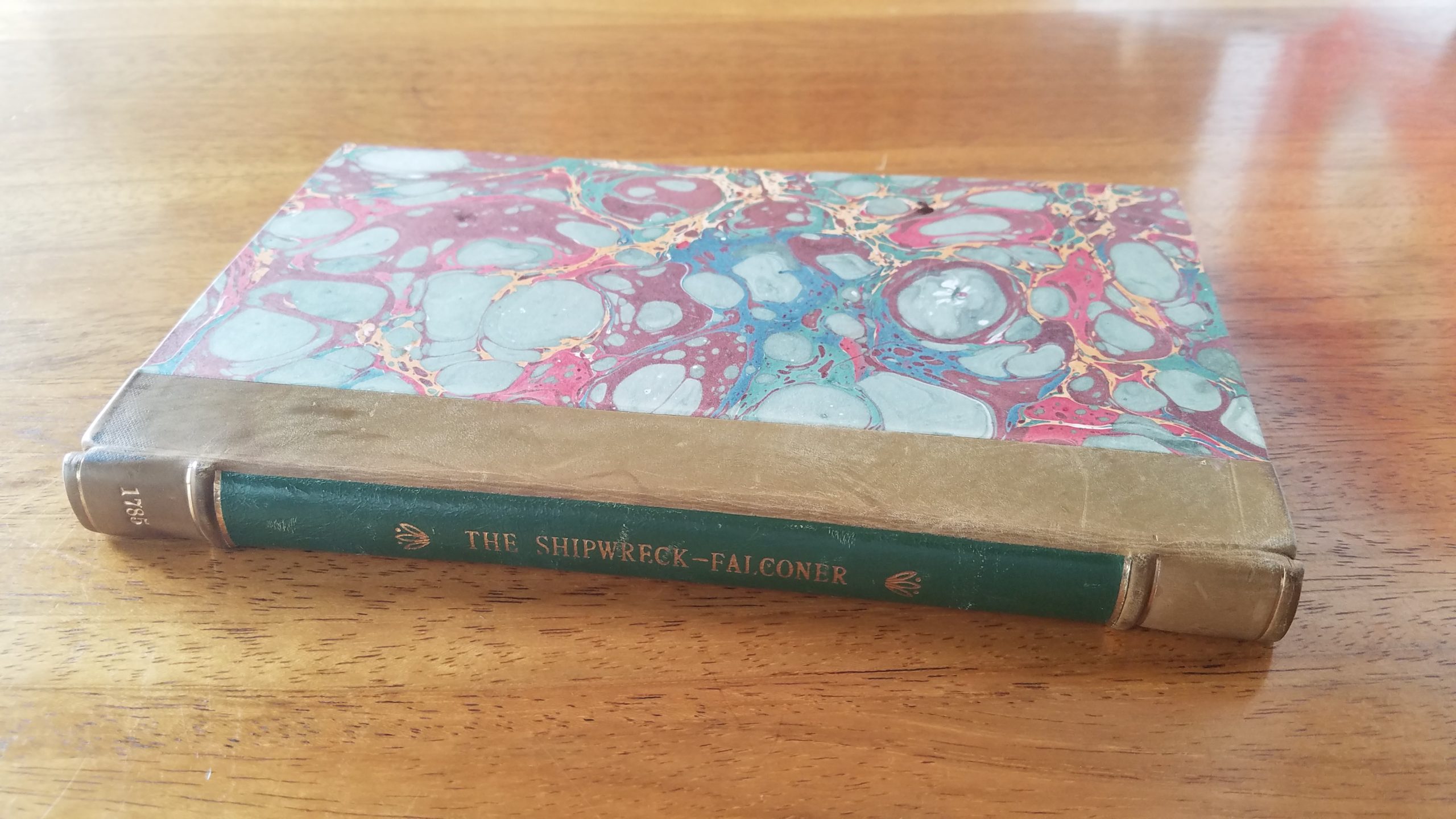
Both plates are included in this lovely sixth edition of William Falconer’s epic poem, The Shipwreck. This particular copy was printed by T. Cadell in London in 1785. The 149 pages have been rebound in marble boards with a gilt leather spine and the book is in very good condition overall. Below is an overview of the publication provided by the blog of the Royal Museums at Greenwich (link).
The Shipwreck was first published in 1762 with Falconer ascribing authorship to ‘a sailor’. Following its success, the second edition was published in 1764 and Falconer made considerable changes to the work, expanding this edition by over 1000 lines and enlarging the story with new scenes, descriptions and characters. Falconer’s final revision to the poem came in 1769 with the third edition, which was published before he joined the ill-fated frigate Aurora.
This poem is more than a work of pure fiction, however. The Shipwreck is firmly fixed in the everyday workings of a mid-18th century merchant vessel. Falconer was writing from personal experience and The Shipwreck is a semi-autobiographical work. Born in 1732, the son of a barber from Edinburgh, Falconer became a sailor and on a voyage from Alexandria to Venice (circa 1750) was one of only three survivors of the wreck of his vessel.
Falconer brings his personal experience not only of the horrors of a shipwreck but also of the management of a merchant vessel and The Shipwreck is partially intended as an instructional piece for sailors.The delightful fold-out plate provides a detailed diagrammatic glossary of a typical merchant vessel and its rigging, many parts of which are referenced within the poem. The text of the poem itself also contains technical details of sailing and navigation.
Throughout the poem, Falconer uses footnotes to explain such technical detail to the reader. In this case, we are informed that at line 825 studding sails are ‘long narrow sails that are only used in fine weather and fair winds, on the outside of the larger square sails’. Setting instructional detail like this to verse makes it memorable and enhances the didactic qualities of the poem.
Map Details
Publication Date: 1785
Author: Thomas Kitchin, J. Baylys
Sheet Width (in):
Sheet Height (in):
Condition: B
Condition Description: The two fold out plates are in very good condition. The map has a small tear adjacent to the binding and curling along the left edge. The diagram of the ship has a 2" tear adjacent to the binding and curling along the left edge. The book has been rebound in gilt quarter leather with marbled covers. Clean pages on thick paper.
$275.00