
S. 1/2 of N.E. 1/4 Section 34.39.14
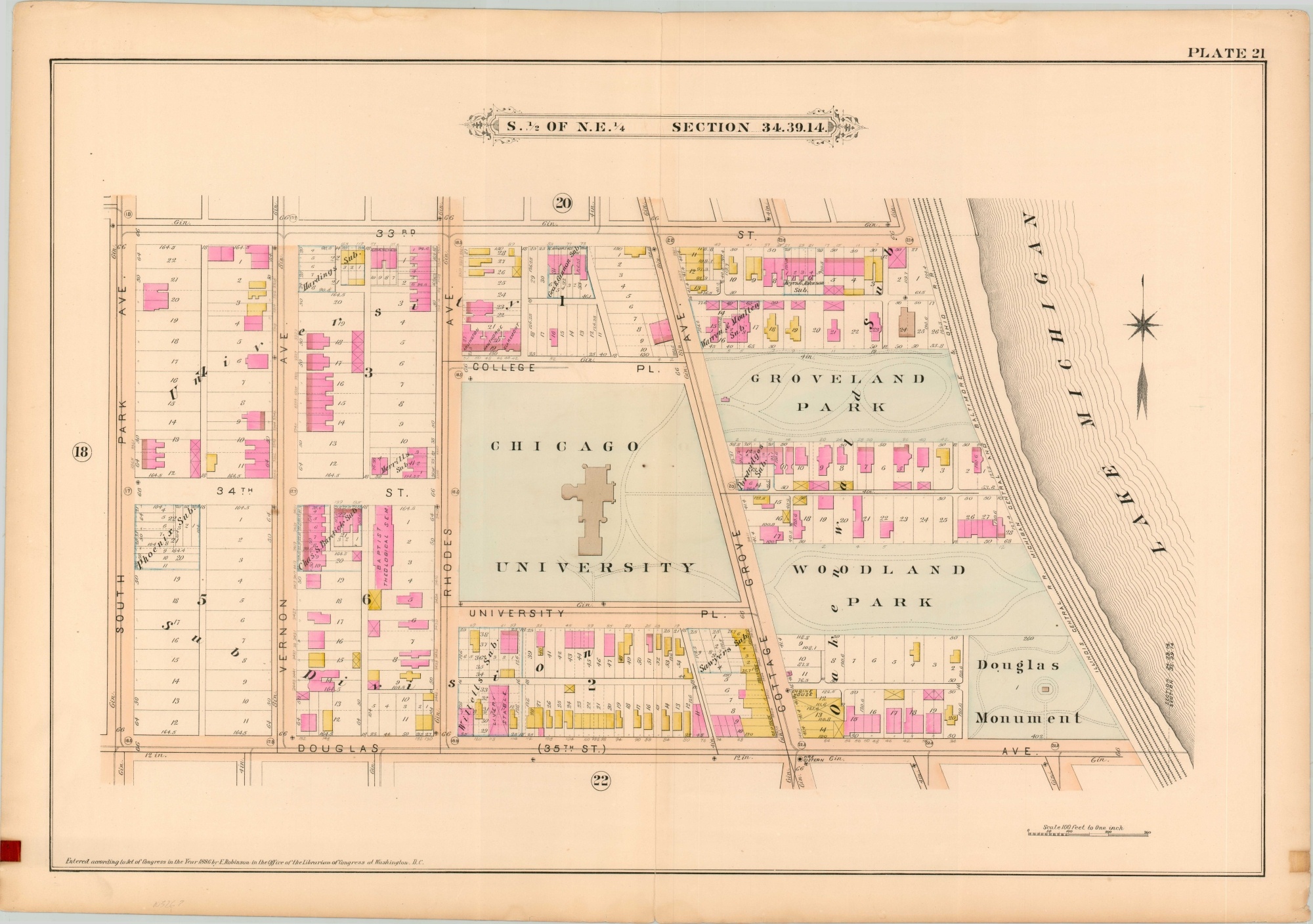
One of the final maps showing the original University of Chicago.
Out of stock
Description
This fabulously detailed map of several city blocks in Chicago’s Bronzeville neighborhood was published in response to the devastating fire that rampaged through the city between October 8-10, 1871. Elisha Robinson, its creator, was one of the numerous publishers who issued atlases specifically for the fire insurance industry.
In order to properly assess risk, insurers needed information on building size, construction material, and the availability of water. Surveys were painstakingly performed, usually on foot, and the results are among the most complete snapshots of the city’s physical makeup in the late 19th and early 20th centuries. This map, in theory, outlines every single building that existed at the time of publication. Color was applied by stencil and shows the construction material of each structure; pink is brick, yellow is wood, brown is stone, and blue is iron. Crosses on a building footprint indicate its use as a stable, or otherwise likely to hold combustible materials. Water and sewer lines, street elevation (which affects the flow), fire hydrants, and cisterns are also all noted.
The image is bounded by 33rd Street, the Illinois Central Lines along Lake Michigan, 35th Street, and South Park Ave and includes Chicago University. Alternatively called the University of Chicago, the building was constructed in 1857 on land granted by Illinois Senator Stephen Douglas (note the relevant monument nearby). Classes would cease in 1886, the same year of publication, after a fire and financial hardships. The ‘new’ University of Chicago’s familiar Hyde Park campus first opened for classes in 1892.
The map was issued as plate 21 from Volume IV of Robinson’s Fire Insurance Atlas. Published in Chicago by Elisha Robinson in 1886. Source.
Map Details
Publication Date: 1886
Author: Elisha Robinson
Sheet Width (in): 32.60
Sheet Height (in): 22.5
Condition: A
Condition Description: Light toning and faint wear along the outer edges of the sheet, consistent with age. Very good to near fine overall.
Out of stock