
[Chicago’s Central Manufacturing District]
Developing one of the first planned industrial parks in the United States.
Out of stock
![[Chicago's Central Manufacturing District] - Image 2](https://curtiswrightmaps.com/wp-content/uploads/map_2023-06-10_22.38x17.17_inv005073.5-scaled.jpg)
![[Chicago's Central Manufacturing District] - Image 3](https://curtiswrightmaps.com/wp-content/uploads/map_2023-06-10_21.99x17.14_inv005073.1-scaled.jpg)
![[Chicago's Central Manufacturing District] - Image 4](https://curtiswrightmaps.com/wp-content/uploads/map_2023-06-10_17.09x11.08_inv005073.2-scaled.jpg)
![[Chicago's Central Manufacturing District] - Image 5](https://curtiswrightmaps.com/wp-content/uploads/map_2023-06-10_8.53x11.13_inv005073.3-scaled.jpg)
![[Chicago's Central Manufacturing District] - Image 6](https://curtiswrightmaps.com/wp-content/uploads/map_2023-06-10_30.03x11.08_inv005073.4-scaled.jpg)
Description
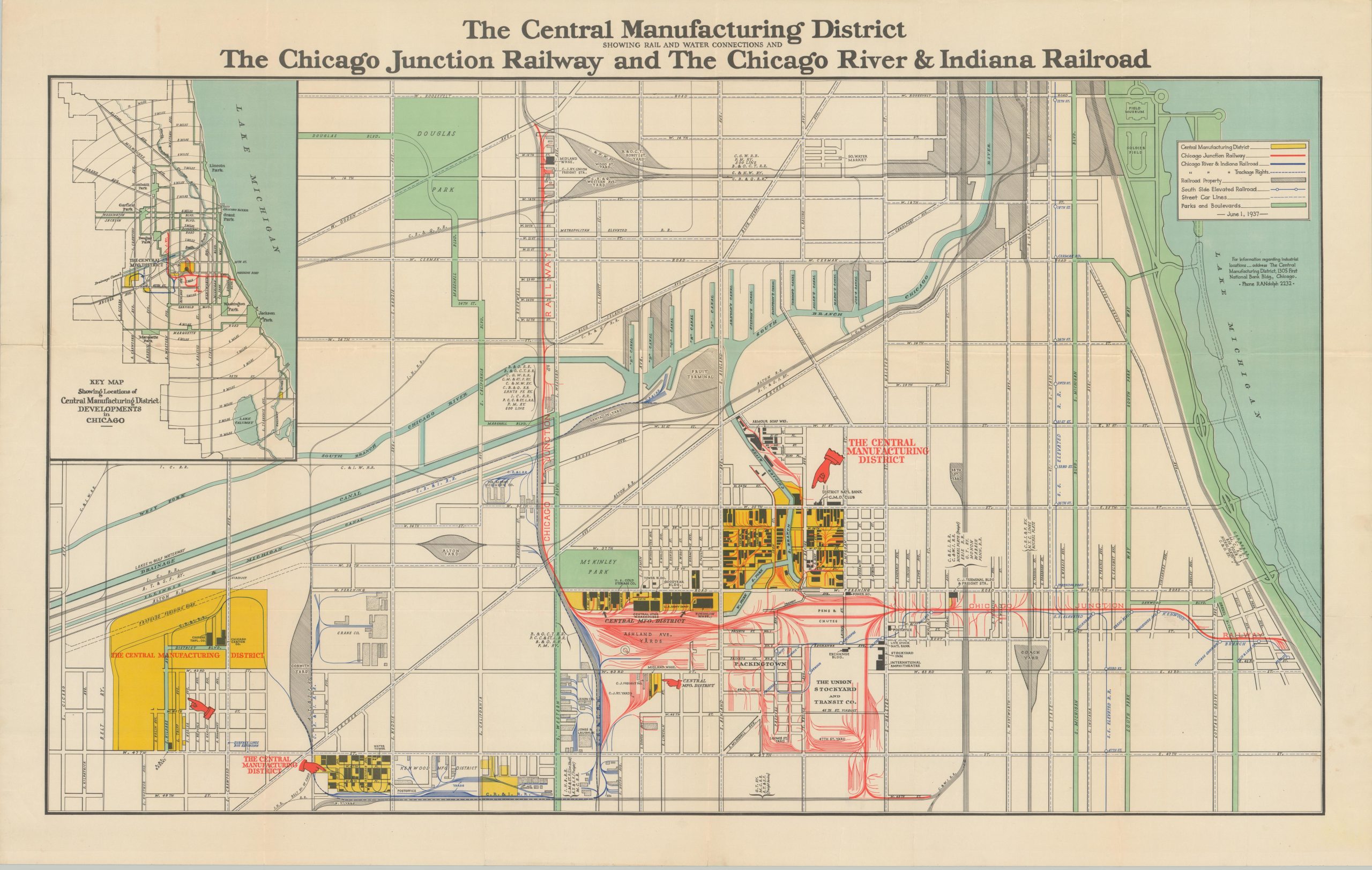
In the early 1900s, East Coast financier Frederick Henry Prince acquired control of the Chicago Junction Railroad, a switching line that connected the massive Union Stockyard to the major railways in the city. Seeking to generate additional tonnage for his line, Prince acquired a tract of land on the South Side adjacent to the stockyards. Streets, sewers, commuter transportation, and other elements of infrastructure were privately funded and installed with the specific idea of attracting new businesses to the area – the nation’s first planned industrial district.
The original 265-acre parcel was an immediate success. According to the Encyclopedia of Chicago, “By 1915, some two hundred firms were using the CMD, many renting space with the option to buy, providing a work location for 40,000 people when combined with the Union Stock Yard. The CMD functioned as private banker, business incubator, and maintenance operator, including landscaping and upkeep of the grounds.”
This incredible collection of maps catalogs Chicago’s Central Manufacturing District near its height, after several additional tracts were added to Prince’s first development. The first and largest map measures approximately 44″ x 28″ and is titled “The Central Manufacturing District Showing Rail and Water Connections and The Chicago Junction Railway and The Chicago river & Indiana Railroad.” It’s dated 1937 and highlights the various properties under CMD control on the city’s South Side. The superb railroad and waterway connectivity is emphasized, with an inset in the upper left showing distances from the CMD in 1 mile increments. A second, 1950s plan of the entire CMD is also provided and shows the tremendous growth of the preceding fifteen or so years. Four subsequent maps, each dated 1954, provide large-scale overviews of individual tracts – The Pershing Road Development, The “Kedzie” Tract, The “Crawford” Tract, and the “43rd Street” Development. With building footprints outlined and labeled, these offer a detailed look at the physical composition of the Central Manufacturing District.
Though the CMD fell into decline in the late 1950s, due in large part to the close of the local elevated line, the decades of success enjoyed by famous tenants like Wrigley, Westinghouse, Goodyear, Ford, and Pullman were used as a blueprint for further industrial developments across the country.
Sources: Encyclopedia of Chicago; Chicagology;
Map Details
Publication Date: 1937 - 1954
Author: Various
Sheet Width (in): See Description
Sheet Height (in): See Description
Condition: A-
Condition Description: Collection of six different maps related to the Central Manufacturing District. All were previously folded and have creasing along fold lines, along with spots of separation, small holes at fold intersections, and light edge wear. Scattered soiling and ink stains visible on a few sheets, most evidently some blue at the top of the Crawford Tract. Overall in very good condition.
Out of stock