
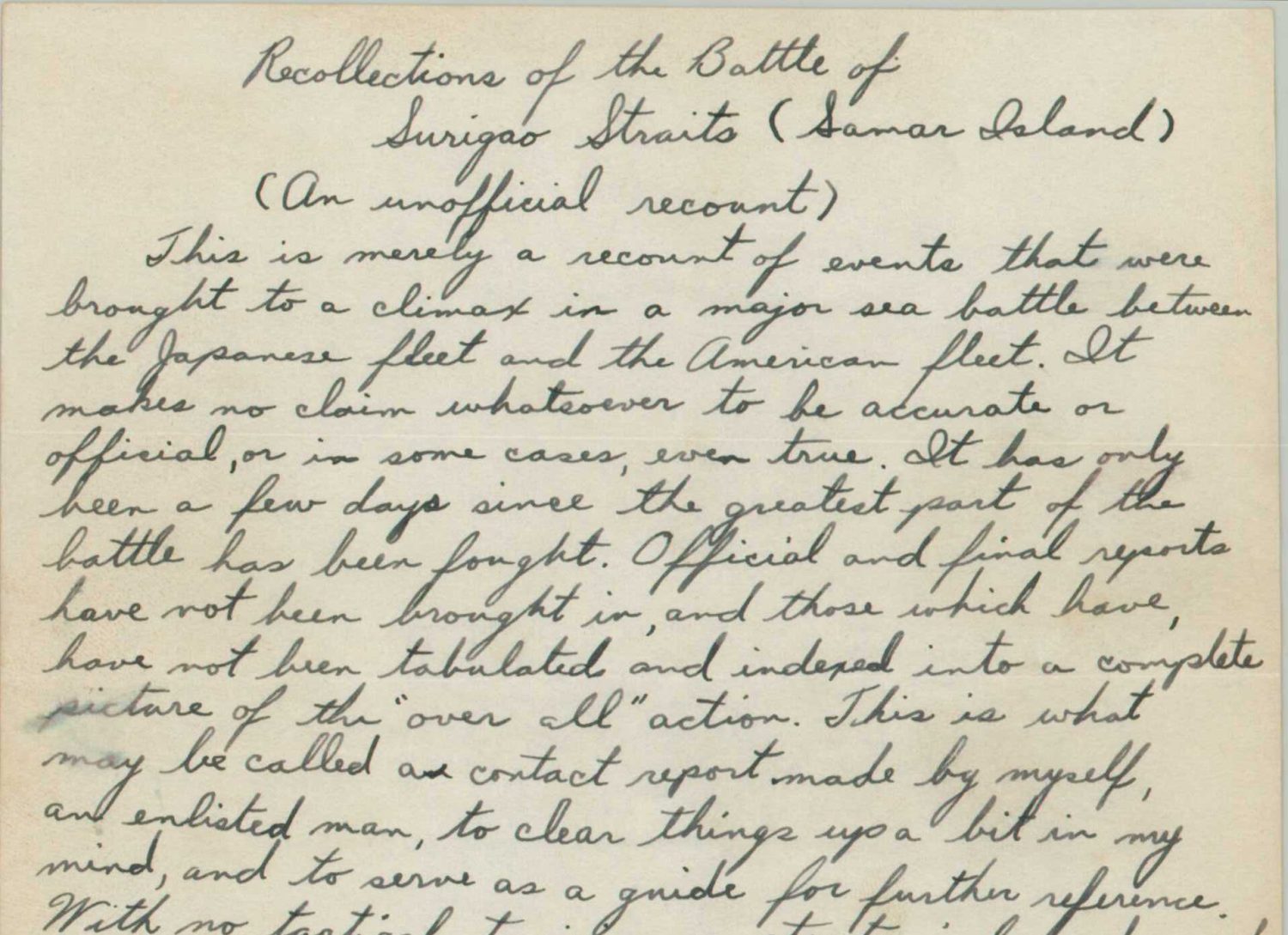
What follows is my transcription of a first-person account of the Battle off Samar, one of the largest and bloodiest naval engagements in the broader Battle of Leyte Gulf. It has been replicated as faithfully as possible, including spelling and punctuation errors. The narrative and an accompanying manuscript map were found in the WWII archive of an unnamed signalman stationed aboard the U.S.S. Fanshaw Bay. The neatly written text, authored less than a week after the battle, provides a harrowing glimpse of the action from the perspective of an enlisted sailor. Hurricane-force winds, the massive 18″ guns of the battleship Yamato, and the second organized kamikaze attack are among the hazards described within the 24 pages. The author’s fear, hope, and awe are transmitted with a vibrancy impossible with a map alone. In addition to a brief background summary below, I’ve inserted numerous photographs (not included with the archive) that I hope add further context to the chaos of the battle.


Background
By the fall of 1944, Allied forces were ‘tightening the noose’ around Japan in the Pacific. The capture of the Marianas in June offered a base for B-29 Superfortresses to bomb the home islands. The Philippines were selected as the next target, beginning with the island of Leyte on October 20th. Responding to the attack, the Japanese launched a last-ditch naval assault to disrupt the amphibious invasion. The resulting four-day battle was among the largest naval engagements in human history.
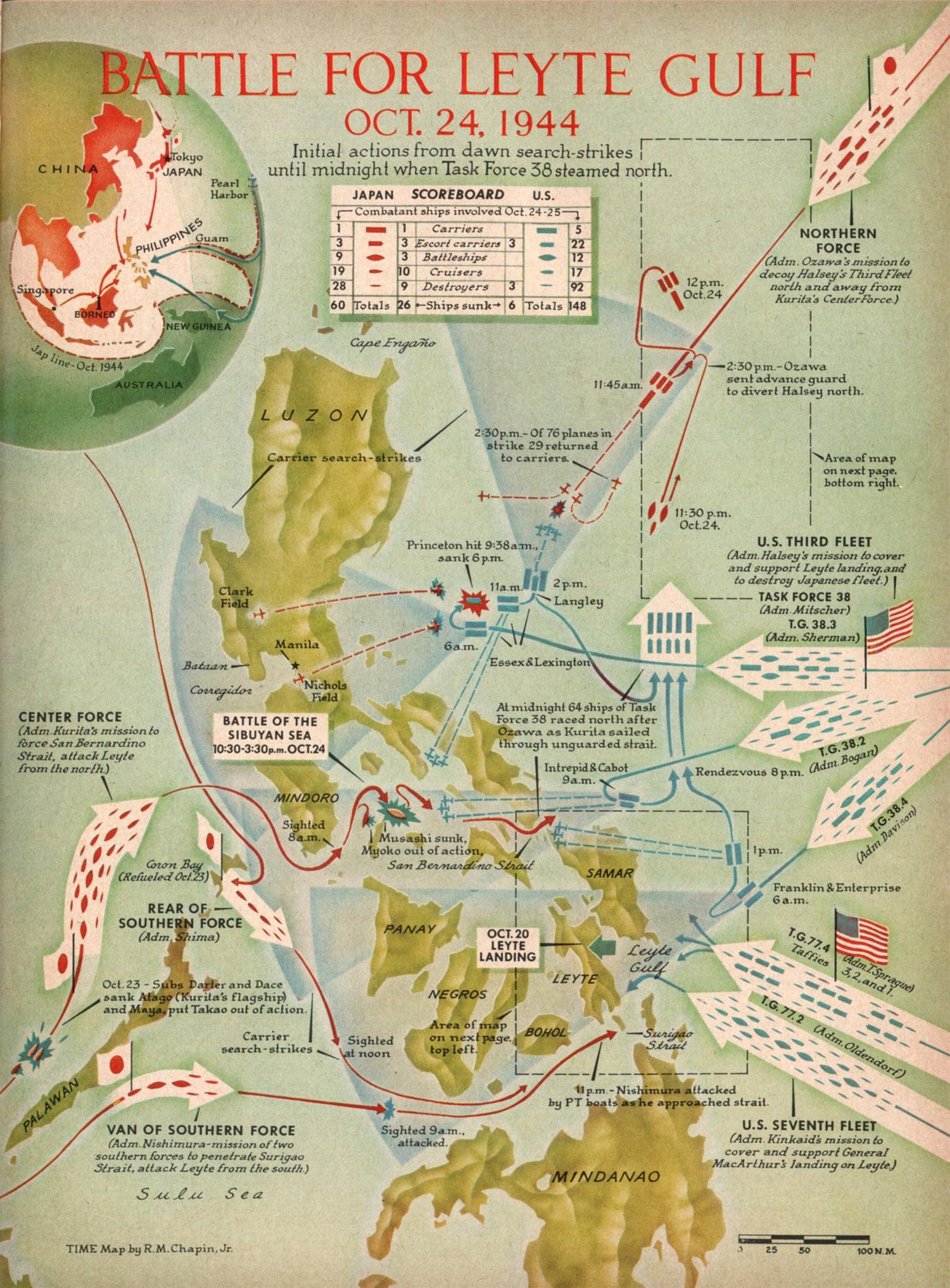
The massive operation was supported by the U.S. Third Fleet, under Admiral William ‘Bull’ Halsey, and the U.S. Seventh Fleet, led by Admiral Thomas Kincaid. The Japanese ships were split into three groups – Northern, Center, and Southern Forces. The first bloodshed of the conflict began on the night of October 23rd, when American submarines detected the Center Force and sank two cruisers. Over the following two days, the various fleets clashed in the Battles of the Sibuyan Sea, Surigao Strait, Cape Engaño, and off Samar. In the last of these, American forces were heavily outnumbered and outgunned.
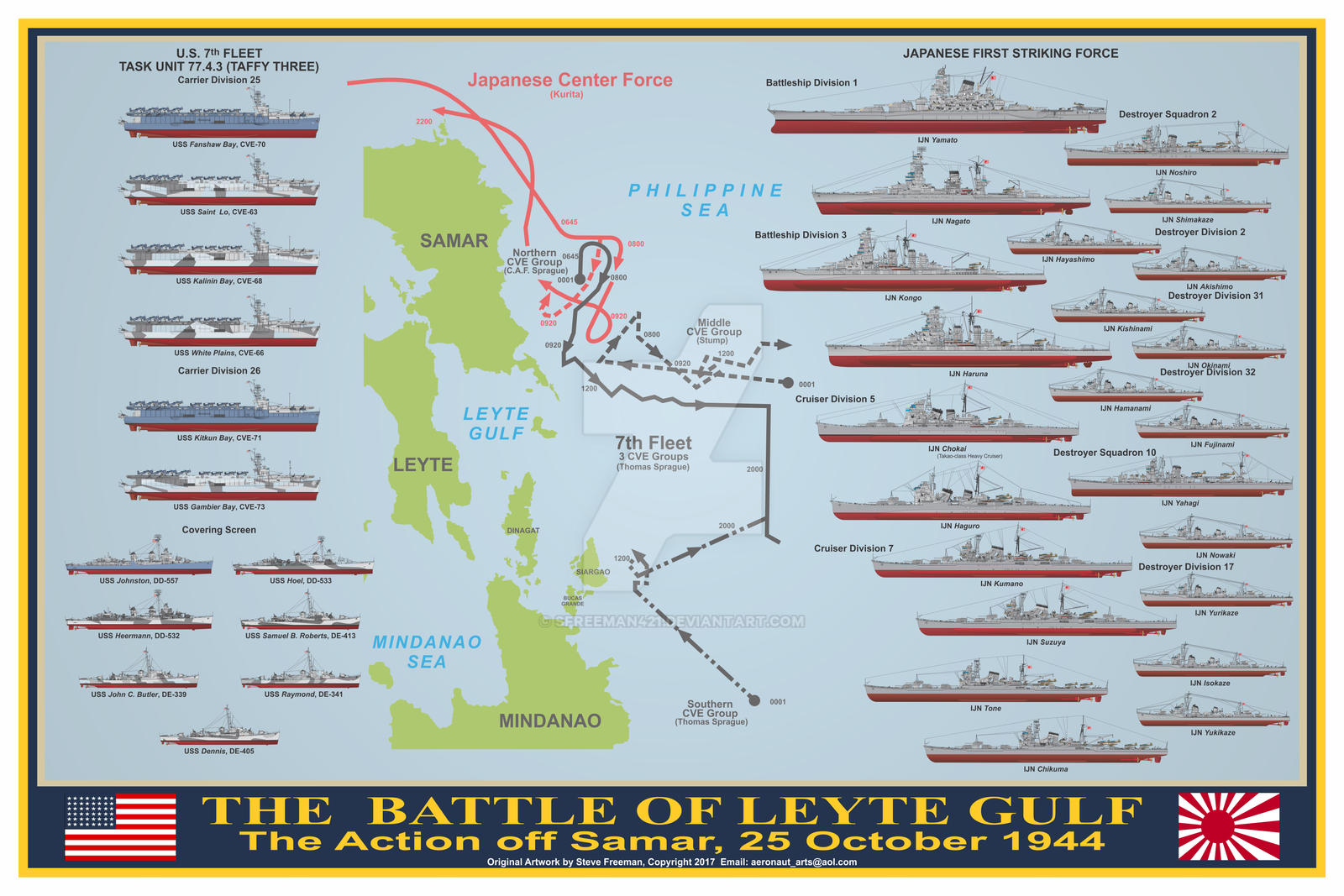
The three task forces (taffies) of the Seventh Fleet were comprised of small escort carriers, destroyers, and destroyer escorts. Charged with defending the ongoing debarkation of troops on Leyte, they were left highly vulnerable to heavier enemy ships when the Third Fleet left the area to pursue the destruction of Japanese aircraft carriers (always a prized target). Taffy 3, led by Rear Admiral Clifton Sprague, was surprised at sunrise on October 25th by the majority of the Center Force bearing down on his thirteen ships. Aboard the flagship U.S.S. Fanshaw Bay, Sprague ordered an immediate withdrawal, with the destroyers and escorts laying desperate smokescreens and torpedo spreads to buy time for the carriers to escape. These heroic efforts were largely successful, but at a significant cost; with the loss of the U.S.S. Hoel (destroyer), U.S.S. Johnston (destroyer), U.S.S. Samuel B. Roberts (escort destroyer), and the U.S.S. Gambier Bay (escort carrier).
Pilots from Taffy 3 and Taffy 2 joined in the defense while the carriers returned fire with their paltry 5″ guns (the Yamato had 18″ barrels). Aerial reinforcements from the rest of the Seventh Fleet eventually forced the Japanese admiral to retreat. Unfortunately for the American pilots and sailors, this was not the end of danger. The second organized kamikaze attack of the war (the first occurred just hours earlier, in Surigao Strait) was ordered to depart from Luzon. Five suicide planes were successful in sinking the escort carrier U.S.S. St. Lo and damaging three other CVEs.
The Battle off Samar is among the most valiant actions performed by members of the United States Navy during World War II, earning Taffy 3 a well-deserved Presidential Unit Citation. The selfless efforts of the escort vessels against an overwhelming force of enemy battleships and heavy cruisers reflect tremendous dedication to duty. This spirit was captured by the words of Robert Copeland, Commanding Officer of the U.S.S. Samuel B. Roberts and winner of the Navy Cross. That fateful morning, he calmly informed his men they were heading into “a fight against overwhelming odds from which survival could not be expected, during which time we would do what damage we could.”
The parallels with the kamikaze pilots, likely given similar encouragement, cannot be ignored. Men were ordered to their deaths on both sides, an inevitable reality of war. Apart from the evident ideological divide between Japan and the United States, another difference is the impressive efforts America made to recover its lost troops. Sailors and pilots in Taffy 3 had hopes of rescue in the event their ‘boat’ (plane or ship) went down. Those crews, comprised mainly of twenty-somethings, did not meet the enemy with a death wish – they did so to protect their friends on board, the other ships in the fleet, the soldiers on shore, and their families back home.
Transcription
Recollections of the Battle of Surigao Straits (Samar Island)
(An Unofficial Recount)
This is merely a recount of events that were brought to a climax in a major sea battle between the Japanese fleet and the American fleet. It makes no claim whatsoever to be accurate or official, or in some cases, even true. It has only been a few days since the greatest part of the battle has been fought. Official and final reports have not been brought in, and those which have, have not been tabulated and indexed into a complete picture of the “over all” action. This is what may be called a contact report made by myself, an enlisted man, to clear things up a bit in my mind., and to serve as a guide for further reference.
With no tactical training and no strategical background much of what may follow will be controversial and debatable. Very much of these recollections are “scuttle-butt” and under strain of emotions, and memory, and battle, much may be said that has no basis whatsoever in actual fact. This is merely impressions that took place in my mind and no one else’s. I lived through that battle and what I felt in detail, was felt by no one else and it would be impossible for a duplication of those feelings and emotions. This is my private battle.
It is hard to know exactly where to start in an undertaking of this sort. Should I describe the actual battle with its vivid action alone, starting from the time the first gun was fired till the last shell fell? Or should I combine with this the reason that such an event took place at that chosen moment. It is quite a problem. One view would be too short while the other would take into account things which happened long ago that had, and have, a very small bearing on what happened. Perhaps some sort of compromise may be made. I will try to cover most of the battle in that manner, but have little hope of succeeding completely.
This account, together with other stories and articles that are written, may furnish me a guide with which I may, in future time, be able to synthesize a picture of what war is like and thus try to explain it to future generations, although that too would be impossible to do completely. Perhaps my “picture” together with other’s pictures may someday for a complete understanding of what war is and thus armed it can be guided differently than it has in the past. Since I personally can make no sense of belligerency and battle to the death I hope that this picture I have formed in my mind will eventually lead to eradication of wars and peace will reign supreme.
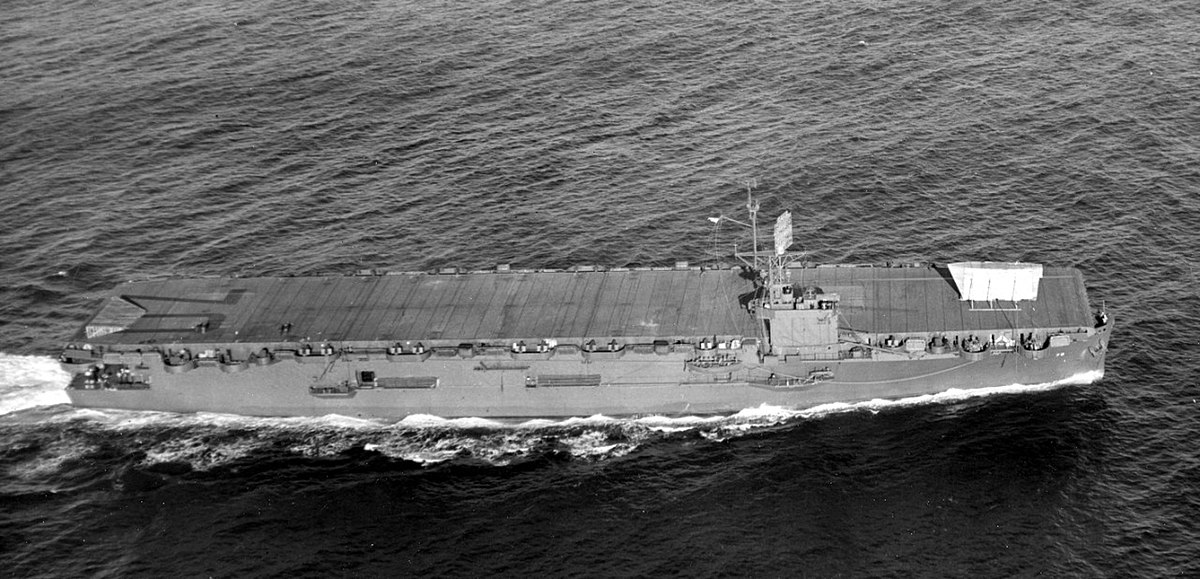
I was aboard a unit of the United States Navy, at sea somewhere off the coast of the Philippines. The unit was a Kaiser-built CVE or aircraft carrier, escort. There was a larger unit composed of six of these CVE’s and seven DD’s (destroyers) and DE’s (destroyer escorts). From word of mouth, and a quick glance at a chart, that I happened to pass the particular island that was nearest us, was Samar. There were two more similar units in the vicinity also. One unit, however, instead of being built from keel-up as aircraft carriers were converted tankers and oilers. They were slightly larger and I believe slightly faster, by some two to four knots.
The top speed reached by us on the day of the battle was a shade over seventeen knots. There was also another carrier group composed of two to three CVL’s (carriers converted from cruisers), a CV (aircraft carrier) of the Enterprise type, a BBC (battleship) perhaps two and a group of DD’s and DE’s as escorts, also in the vicinity. It was rumored that this was Halsey’s fleet. I had a rather hard time believe this, as Admiral Halsey had, to our reports, been fighting the Japs in their own backyard practically (around Formosa). It seems most unlikely that he would have done this with so little a force, although to a unit like us it was rather formidable.
Our base, from which we had departed last, was Manus Island. We left there (our unit) October 12. Some of the ships which were there when we arrived at base pulled out before us and many did not leave until later. The force I saw there was truly magnificent, some 200 ships and boats of all types being represented. All gathered into a large lagoon formed by small islands grouped in such a manner that they formed a rough circular bay with small openings between the islands that served as entrances.
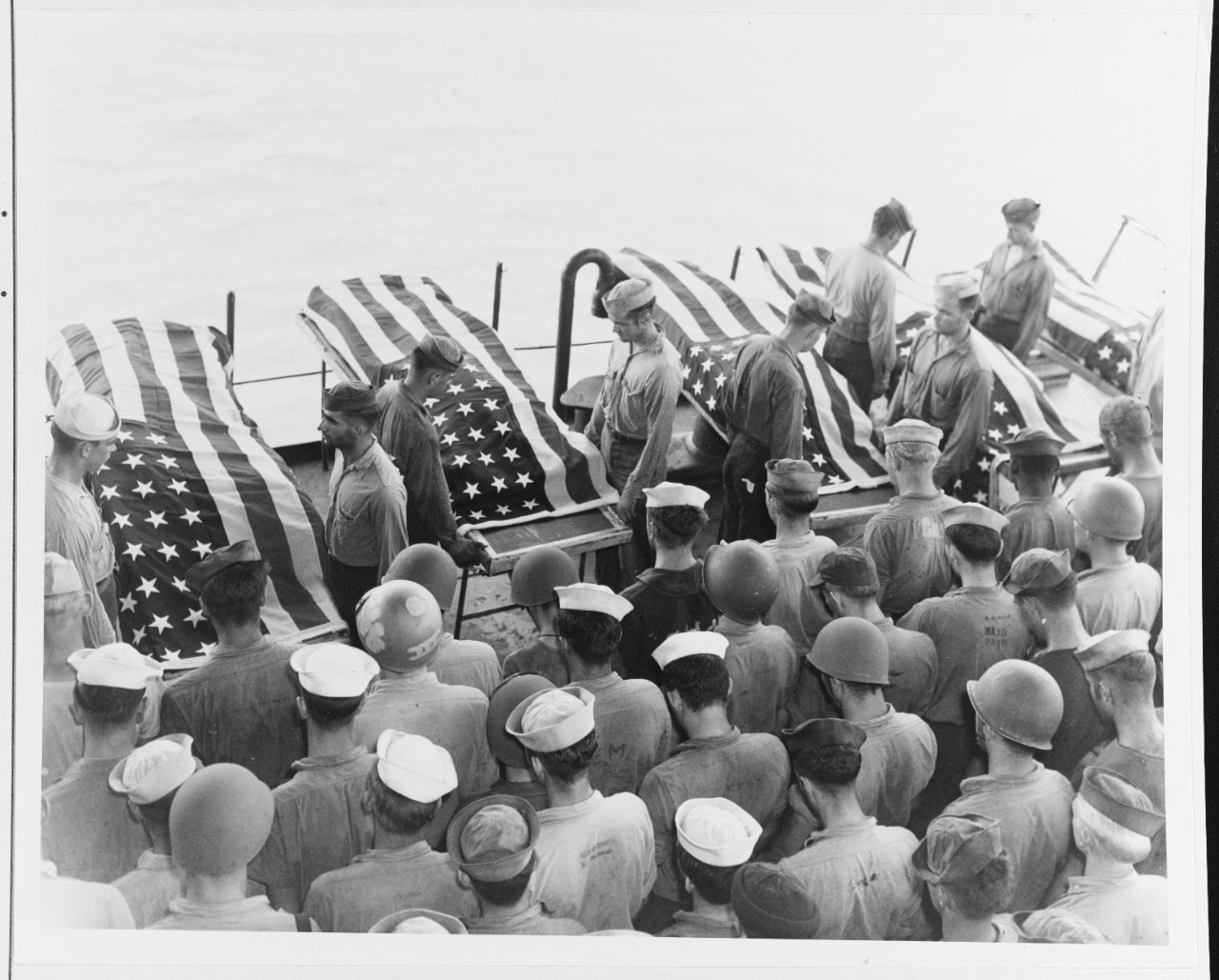
To begin with, the first event that was memorable was that one of the flight deck crewmen was caught in the forward elevator as it was rising into position, and a result of injuries died very shortly afterwards. He was injured just a few minutes before we got underway. It is rather unpleasant to talk of the death of a comrade-in-arms, so let it suffice right here to pay tribute to in memory of McAfee. I stood by on watch for one of his pall-bearers.
The next memorable event was the weather. Perhaps it seems odd to mention here, but it is important to a seaman, so it must be discussed at one time or another in the course of any discussion about the sea.
The wind was rather chilly to most of us, who had been near the Equator for some six months. There were frequent squalls, and the wind was rather strong at times. In time, it developed into a hurricane. This was on the night of the 16th of October. We were all in our own “sacks” when we all eventually became awakened from the pitching and rolling of the ship. Every once in a while the whole bow of the ship would be lifted out of the water and would crack down with a resounding crash that shivered the ship.
At times like these I would talk silently to myself, ever-urging the ‘old girl’ to take it easy. Then I would fall asleep for a while again, and the actions would be repeated one more. The time – approximately 11 or 12 o’clock (2300-2400). I happened to be awake at 3:30 (0330) when one of the fellows on watch came down to call me to relieve the watch. He was wearing, and passed to me, rubberized pants, and coat. I was his relief, so I was more prepared to face the storm than the rest of the fellows who were there on watch with me. They had to get into their rain gear when they got top side.
When I reached top side I was greeted by rain and wind in large quantities. Feeling my way across the flight deck through the blackness I was picking my way carefully as I thought of the lack of adequate railing and barriers that could stop me being washed overboard under a combination of circumstances. Perhaps a sudden roll, a high wave, and a strong wind would be the cause of another tradgedy [sic] of the sea. And once overboard there could be no rescue in that Stygian blackness, and howling wind would stifle any cries for help.
With these thoughts I reached the bridge. The signal bridge was deserted when I got there, as there was too much exposure to the elements there. It had been often remarked that “Hope this ship never goes up to the Aleutians, will all die of pneumonia or freeze to death. Feeling my way around the open bridge I located the rest of the watch. They were standing aft on the leeward side to starboard. After a few comments one of the other fellows left to move forward. I was left alone when I happened to thing of changing the position of my life-belt from the inside to the outside of the rain gear (it was rather loose fitting and large), “just in case.” This seemed possible as the ship seemed that it would never recover from a particularly far roll. Thus I took off my jacket and unfastened my life belt.
The other fellows happened to come back at this time so I told him to hold it for me while I fought the wind to put on the coat again. We both agreed it was a good idea to wear a life-belt at times like these. Then in a sudden fury the wind blew the rain almost horizontal and the other fellow left to seek better shelter. He set my life-belt on a nearby desk but the wind blew it off and as the belt hit the deck onen of the carbon-dioxide bottles that were used to inflate the belt was punctured and one of the two chambers in the belt was thus inflated. I then deflated the belt and put it on. I then moved to the extreme forward end of the bridge and took up my vigil there.
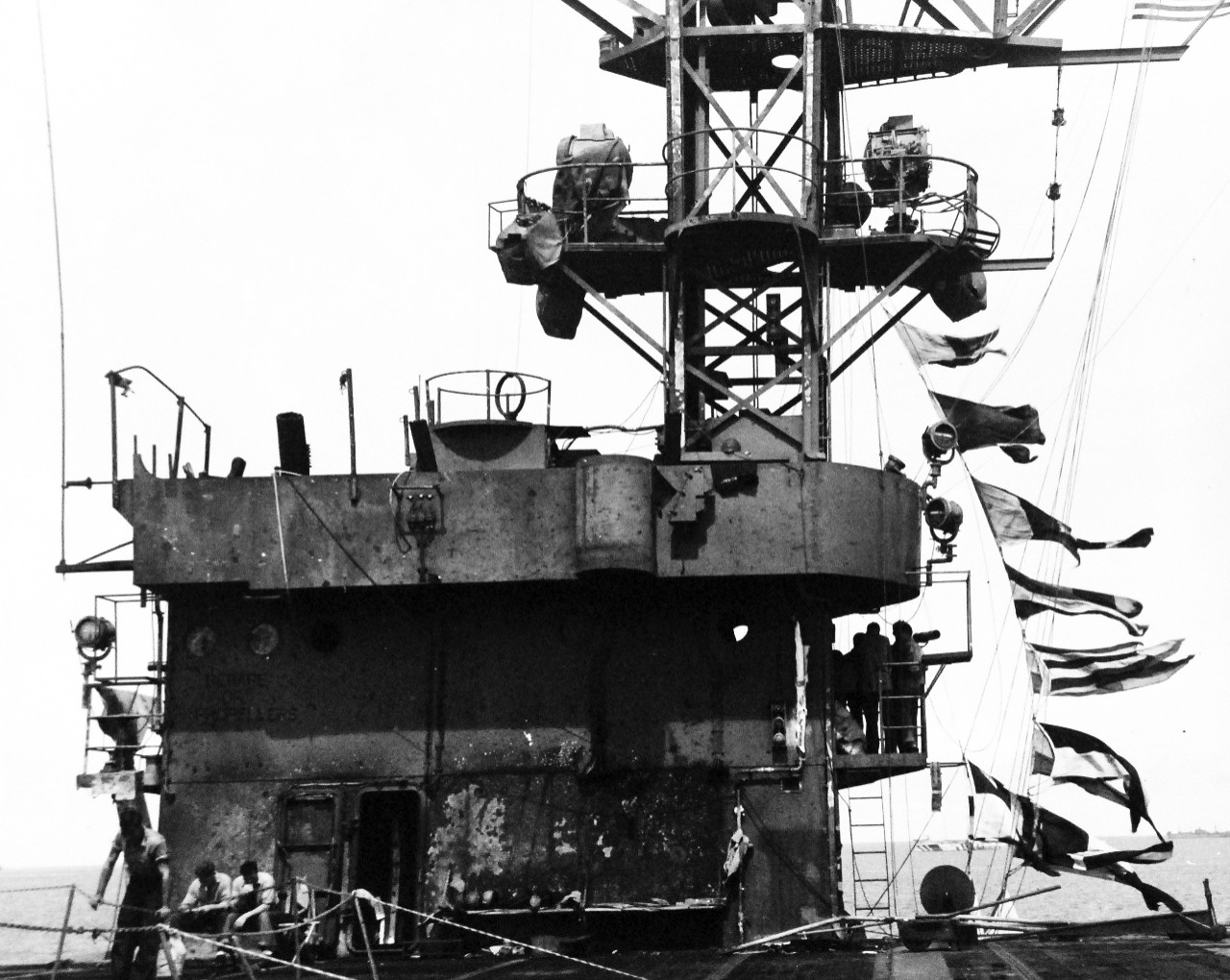
The only thing that could be seen at all was the dim outline of near-by objects and the white-caps of the huge waves as they broke. Occasionally words from the Officer-of-the-Dick and the Junior Officer of the Watch could be heard. Courses and instructions to the steersman were the usual orders and totaled their conversation. Then the radio transmitter opened up to announce “What is speed of wind ____?” Blank for name of ship. Reply was coded but the O.O.D. broke it down and said “Hah – 55 knots across the flight deck.” If we were headed into the wind we would be facing about 65 to 70 knots of wind.
Occasionally I would give the “old girl” another comforting word and then I would sing silently to myself. Everything from the “Marines Hymn” to the latest song hits were in my repertoire. Then I located the supervisor of the watch to tell him where I was for future reference. Later he came up and asked how I liked the storm. I replied it was all right. He left. Then the radio stuttered again to announce that “Operations cancelled.”
The wind seemed to have died down somewhat although the ship still often crashed into the water and the spray (if not the waves) from the waves was occasionally blow across the flight deck. Then the reveille sounded with the shill pipping of the bosun’s (or boatswain’s) pipe. It was meaning dawn but it was still very black. Then the morning alert was sounded and all men manned their battle stations. Nothing happened as the men huddled up in the slightest protection from the stinging rain. We were a miserable looking company and it grew light enough to see. There were several times when it was difficult to keep footing on the slippery, sloping, steel decks.
As the gray morning wore on we could see that there were twenty to 35 foot waves lashed by the cat-o-nine-tails of wind-driven rain. It seemed as though the ship would rise to the crest of some huge save, then the wind would dispel the wave to let the ship drop again with a crash.
At 0800 (8:00 o’clock) I was told to go below, pass on my rain gear to my relief and go to chow. I complied and had a breakfast of beans, figs, coffee, etc. Often I had to shift weight as I was eating to keep the bench and table that I was using. Often tables or bench did shift a foot or two before it was sopped.
After eating I looked out on an open hatch-way on the hangar deck to see the twenty-foot waves dashing by from starboard to port, as we had changed course to southward to avoid the center of the storm. I wondered if this would delay D-day or A-day as it was called for this operation. This was on the morning of the 17th.
I then turned in my sack again as I knew there was to be no cleaning or work to be done that morning for me. As I was sitting in my sack writing a letter, the chaplain said the daily morning prayer. He thanked our Lord that he had protected us from the storm. It was a very nice prayer that he said in all. All thru’ it we could still hear the howl of the wind as he had gone topside and was talking from the transmitter on the bridge.
After finalizing my letter I believe I fell asleep once more. Then, at any rate, it was time for chow. After eating I know I went to sleep that afternoon. I was awakened once more to go to early chow so as to relieve the watch. The sea was still rough altho’ comparatively quiet to what it had been. On watch we only had a few signals to hoist and it was uneventful although one of the halyards was snapped.
Then we secured for the night and I went below, and hit the sack once more, after taking a shower. The next morning we had turned back to carry out operations as scheduled. Halsey was reported to have done pretty well against the Japs although scuttle-butt had it that he didn’t come off unscathed. The sea was much calmer now. The hope was in me that the storm would hide our movements from the Japs. At about 0800 we launched the first flight that was to hit Leyte that day. We were out of sight of the island which I later found out that we never approached closely. We then went into regular routine. Perhaps several alerts but nothing exciting happened.
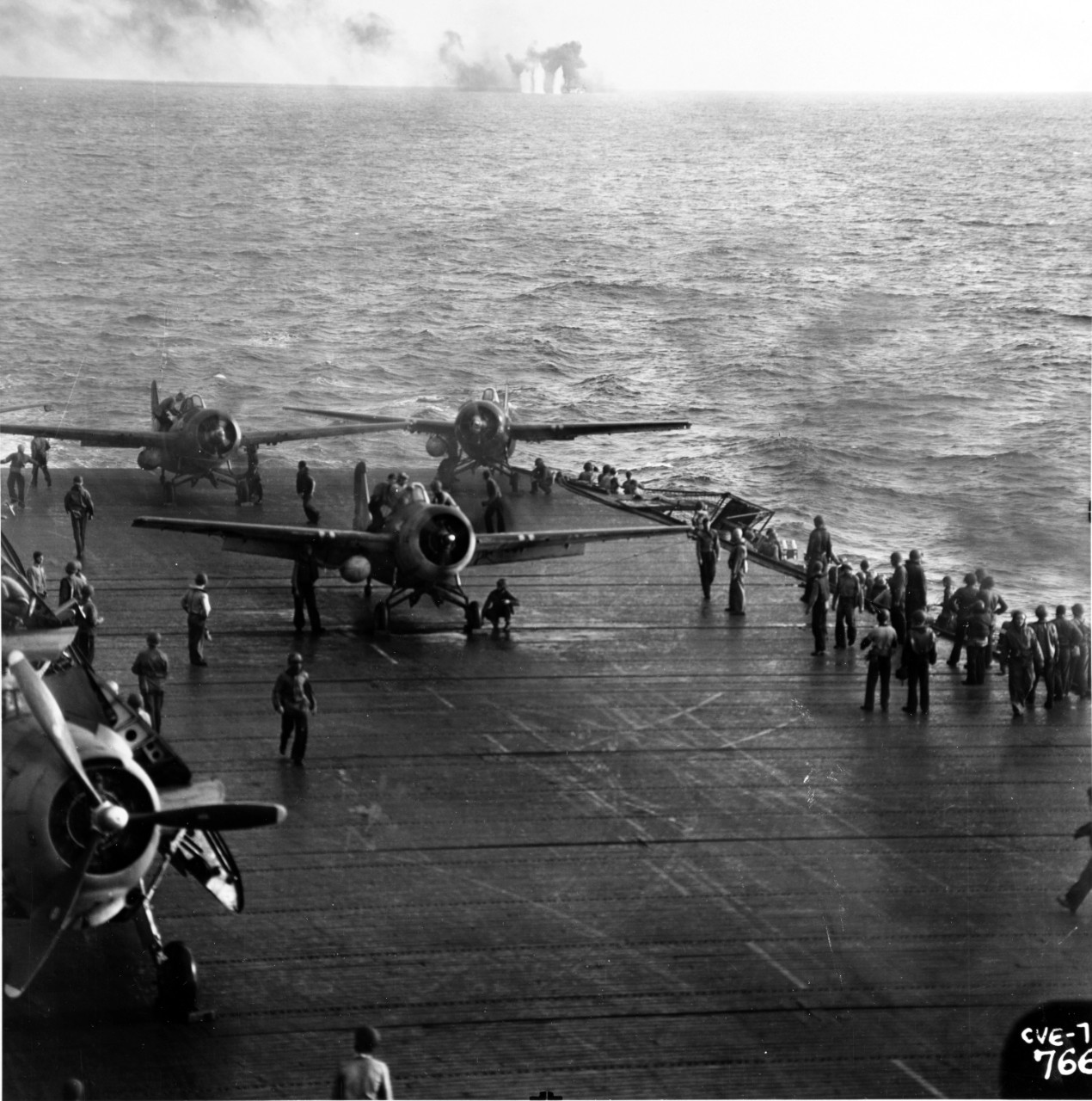
The twentieth of October was D-Day and the landings were made successfully with only minor opposition from the enemy. The 21st, the next day I heard one of the pilots saying that the Marines had orders to advance until stopped, while the Army only had orders to go just so far, and no farther. They complied and when they reached their designated spot they halted and bedded down altho’ they could have gone much further. But that was only the pilots opinions.
We had a very good squadron aboard with us now. They made very good landings as they returned to the ship. They made very few crack-ups on this operation. About October 22 or so we had quarters for muster on the flight deck that morning. We were told that there was cause for celebration as over 2000 landings had been made on the ship. And considering the few crack-ups that made us feel pretty good. Several hours later we had a plane crash into the barriers as it tried to land. It landed alright – right on its back. The pilot was not cut up much but they said something was the matter with his back. Perhaps it was broken. X-rays could only tell. Scratch one pilot temporarily, at least.
Reports were coming in as to show well our planes were supporting landing forces. Many trucks were hit. Several sampans also. Our carrier did very well in strafing trucks and buildings.
On the morning of the 24th of October as day came on we saw ships on the horizon. It was that larger aircraft carrier force mentioned before. They stayed on the horizon almost all that day, but disappeared about dusk, from my view. We felt much safer with them in the vicinity. We had several alerts that day. No results however. That night the scuttle-butt had it that the Jap fleet was coming and that Halsey expected to meet in the next morning. But we didn’t worry too much as we expected the closest the battle could come to us would be anywhere from four hundred to 600 miles away. Halsey wouldn’t let us down.
The next morning we went to morning alert before sunrise. We had been warned by the P.A. system that if we were coming topside, to wear foul weather gear against occasional chance squalls. I hurried topside and managed to get a regular raincoat that was pretty good. It was very much like a black trenchcoat. Light but efficient. We were about to secure just at sunrise, but they had two bogies reported so they delayed us a few minutes.
Just about then that invisible grape-vine that seems to be more efficient than any P.A. system that exists between the enlisted men voiced “anti-aircraft fire going on.” I didn’t see any of it myself, but when the direction of it was pointed out, I expected that it was “Halsey’s Fleet,” under attack by Jap planes.
Then they said over the grape-vine that there were surface ships coming over the horizon. I looked through a powerful telescope at them and saw several masts, and then I happened to see one sticking up quite a way. Strangely enough I saw what appeared to be two cage masts on either side of a stack or three masts and or bridges. There seemed to also be five signal lights going all at once too. I figured that there were three lights but two of them were pointed through the masts in order to reach a ship in an awkward position. There were two lights going on the two outside structures and one in the center structure.
Then someone else wanted to see so I relinquished the telescope to a better authority on ships. I always have difficulty in identifying ships so anyone was an authority to me. Then it was said that those were Jap ships. That was very hard to believe. I first thought “Aw, that’s that group of ships that we saw yesterday.” Then one of the fellows who was on the telescope started counting the ships he saw. “One-two-three-four-five-six-seven-eight-nine (by this time I was staggering) – ten – eleven – here I broke in and said shakily, “That’s enough, what do you want to do scare me to death?”
It seemed that that was just about the size of the force we saw yesterday on the horizon. No mention was made of what kind of ships they were right then so I assumed they were carriers cruisers and destroyers and maybe a battleship or two. I thought it was Halsey’s fleet coming to join us. There was an argument on the bridge now between us as to who or what it was. I was terribly frightened and suddenly said it had to be Halsey’s fleet.
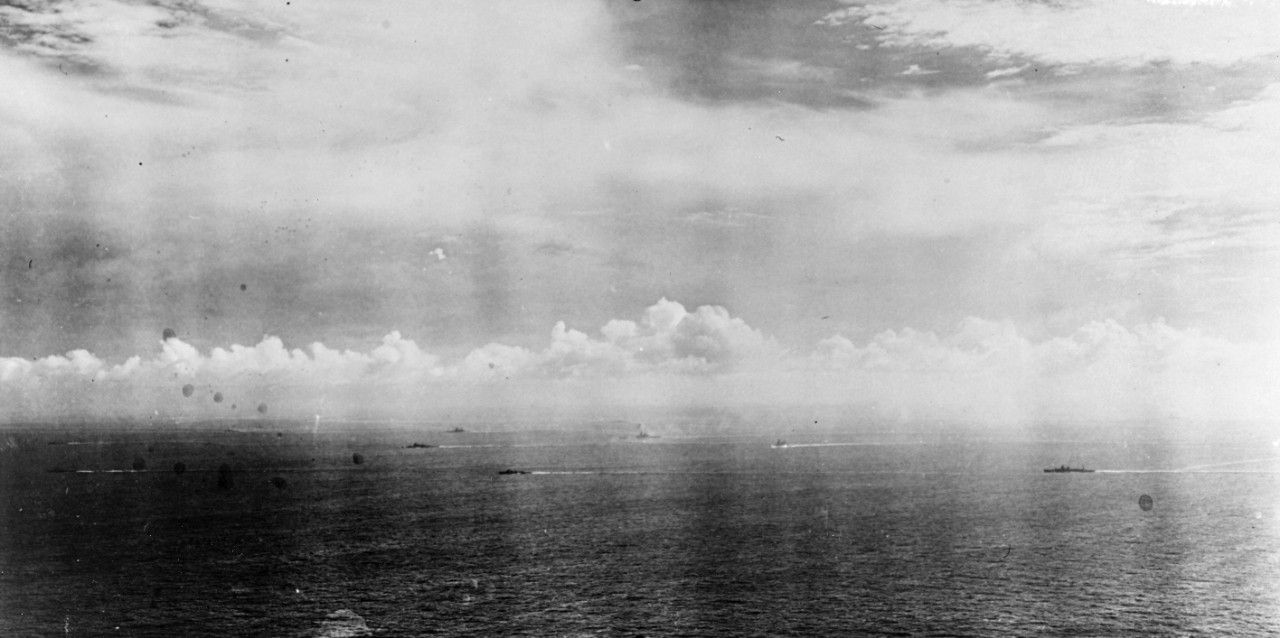
They must have mentioned it at sometime, that there were four battleships and six or seven cruisers. That sounded more like Halsey’s force with which he raided Formosa to me. Suddenly there were grave doubts in my mind as to whether it might not just possibly be the Jap fleet. My mind was in a turmoil for sure. Halsey or not? That was the question. But why would the Jap’s throw all that against us? And what could we possibly do to escape? My lips did lip-service to my hopes while my knees did service to my fears. It couldn’t be Japs. That’s all there was to it. It couldn’t be Japs.
Meanwhile there were several messages coming in and being received just as tho’ nothing unusual was up. We all just put on our helmets now and then or slightly before then, the silent shout went up that they had opened fire on us. I was shaking something awful. I was signal bridge messenger and I had a great desire to leave that horribly exposed bridge. I serviced the messages putting down the times they were received and I had a very hard time controlling the motions of my pencil while thinking of horrible crashing shells coming straight at me. I started down the ladder to the open bridge to go thru’ the motions of delivering the messages. I was hoping I could go below to the communication office with the copies. But no, the first authorized officer I started to show them to waved me off and said “not now, later.” Foiled right at the beginning.
By now, there had been several salvos from the enemy’s guns fired at our group. But more came near our ship as yet. Meanwhile we had gone into flight quarters and were starting to launch planes. At first there was a slight delay while we attempted to load our planes with torpedoes, but it was decided that there wasn’t time to do so, so the order was to load up as well as the crews could and – take off. 100 pound bombs, 500 pound bombs, depth charges, rockets, and machine guns and perhaps small sized torpedoes. We sure weren’t loaded for bear. Bird shot against .45’s was a comparison.
The planes took off as we speeded up to full speed. Meanwhile I asked the signal officer what I should do with the messages I had, and was supposed to deliver. He told me to wait till the action was over or at least calmer. Meanwhile he was putting on flash-proof gear to protect himself from flash burns. During all this time shells were hitting the water all about our unit. Now that I was released from my duty I felt much easier in my mind. Then the signal officer told me to inform the men on the signal bridge to spread out to other parts of the ship; flag – bags, etc. I gladly went to carry out this order, but there was no need for it. Everyone had already dispersed. Only four men were left on the signal bridge, just in case any traffic did come up. I decided to stay on the open bridge, for there I could see everything, terrible and frightening as it was.
I have been told that I’ll ask foolish questions about the action when I am under fire. Well this time I could see almost everything, so I would be happy in that I would know all that went on. I was now free to move freely about the bridge as long as I kept out of the way of officers. Also free to look about us and see the red, blue, yellow, and perhaps green (I’m not sure now) geysers of water that were thrown up by the Jap’s shells as they hit they the water. I didn’t know the reason that the Japs used such coloring matter in their shells but it was more than likely used to help them find ranges.

I really became aware of them the first time when shells were dropping astern of us. Of the Japs. The formation we were in was roughly diamond or rectangular shape. That is the carriers were, with the destroyers and destroyer escorts interspersed here and there. There was one carrier aft of us, another off our starboard quarter, another off our port quarter, another a few points forward our port beam, another on our port bow, and one well forward on our starboard bow. The average distance from us ranged from 1000 to about 1800 yards.
The Japanese were now at a distance of about 10 miles. Their shells were dropping all about us now. About us and the other ships also. Seemed that everytime the Japs fired the shells would all land in a straight line all at once. It was salvo fire. You could see the shells as they hit the water and send up a huge splash. At the base of the splash or geyser you could see the frothing of the disturbed, clear water as the bubbles and air were carried under the surface. Then there seemed to be an area of black, white foam, and the first colorings of the range marker dye. Then above this the dye marker was taking full effect and the spraying water was blood red, vivid blue, or canary yellow, or deep green. Then as the water starting dropping back and air began to take possession the colors gradually faded out until only white spray was at the top, or else the sky was shining thru the spray. One time when I looked directly at some red colored shells I noticed a sort of blackish oil right about the base of the geyser. Probably caused by the powder of the shells.
The Japanese shells started falling astern of us at first on our ship and slightly ahead of the carrier behind us. I’ll never know who they were aiming for – us or them. Then the shells that were closest to us were on our starboard side mostly but quite occasionally on our port side. And similar scenes were occurring on all the other units in our little “fleet.” Salvos was the only way the Japs were firing. While it would be very effective if the whole salvo did hit a ship it wasted up all the shells if none hit at all. Then you knew you had a small respite as all the guns had to be loaded once more before you would have to be actually under fire once ore.
I think we launched about two more planes at about this time. They got off all right. Then we noticed a rain squall ahead of us. We hoped that the Japs would hold off on hitting us for a while until we made the protection of that blessed, protecting squall. We felt that if the squall were big enough we could perhaps lose the enemy. Then it started to rain a few drops at first and as we prayed for more it came down harder. I felt a slight desire to seek cover from the rain, but it was not rain that I was afraid of. Then the squall hid us from sight of the Japs and no more shells fells near us although we could still hear that terrible crack of exploding shells.
Then I thought of our speed, the speed of the enemy’s cruisers and destroyers, and the possibility of meeting in the middle of that squall. To be fired up on at almost point blank range. Not for me. But I had not shivered and quaked from fear for quite some time now. My relief at getting off the signal bridge and not having any specific duties to perform was my source of “courage(?).” I could even banter with one of the phone talkers and ask him why he was shaking.
It was still raining but I didn’t care as I was protected all I wanted to be by the trench-coat rain-coat I had. Then I saw several highly important officers walking about in the rain with no protection whatsoever! I asked several people if they couldn’t find a raincoat for these officers. “They don’t want any”, was the reply, but I still persisted. I found some rain gear lying right beside the station of one of the officers and as he came by offered it to him. He said “It doesn’t matter now.” So I gave up on this idea. Besides it was clearing up now, and once more were would be under fire. I imagined the enemy had fanned out by now and was trying to surround us. I was pretty right in my surmise as there were several cruisers closing in on our port quarter.
Seeing the fine protection offered by the squall, gave the admiral the idea of using smoke to screen and hide our movements. It was done. Although there was some slight delay on our part. Then the subject of us getting hit and some of our own bombs exploding within us was brought up and the word was passed to throw the __ bombs overboard. Some delay here too. Then the Japs started firing at us again but they were more on our port (and seemed a few starboard) quarter. Therefore I moved to the starboard side more often. I was not so afraid of a direct hit then as much as I was afraid of flying bits of shrapnel as shells would hit the ship.
It was then I was overjoyed to see smoke coming out of our smoke-maker. Very shortly thereafter “grape-vine” reported three ships on our port bow. Our interest was diverted that way for a time. Our hope was that they were friendly ships coming to our aid. I hoped they were the biggest and best battleships the U.S. had, and that they were only the van-guard of the whole of the U.S. fleet. We could use it. Then the shelling stopped somewhat, at least on us. Reason: The Japs diverted their attention to our planes, I suppose, although I couldn’t see what they were doing to the Japs. The destroyers just hung on the horizon although they were seemingly going around the Japanese flank. That’s what those ships were finally identified as. We tried to challenge them to find out if they were friendly or not, but there was no reply. I finally forgot all about them in the excitement.
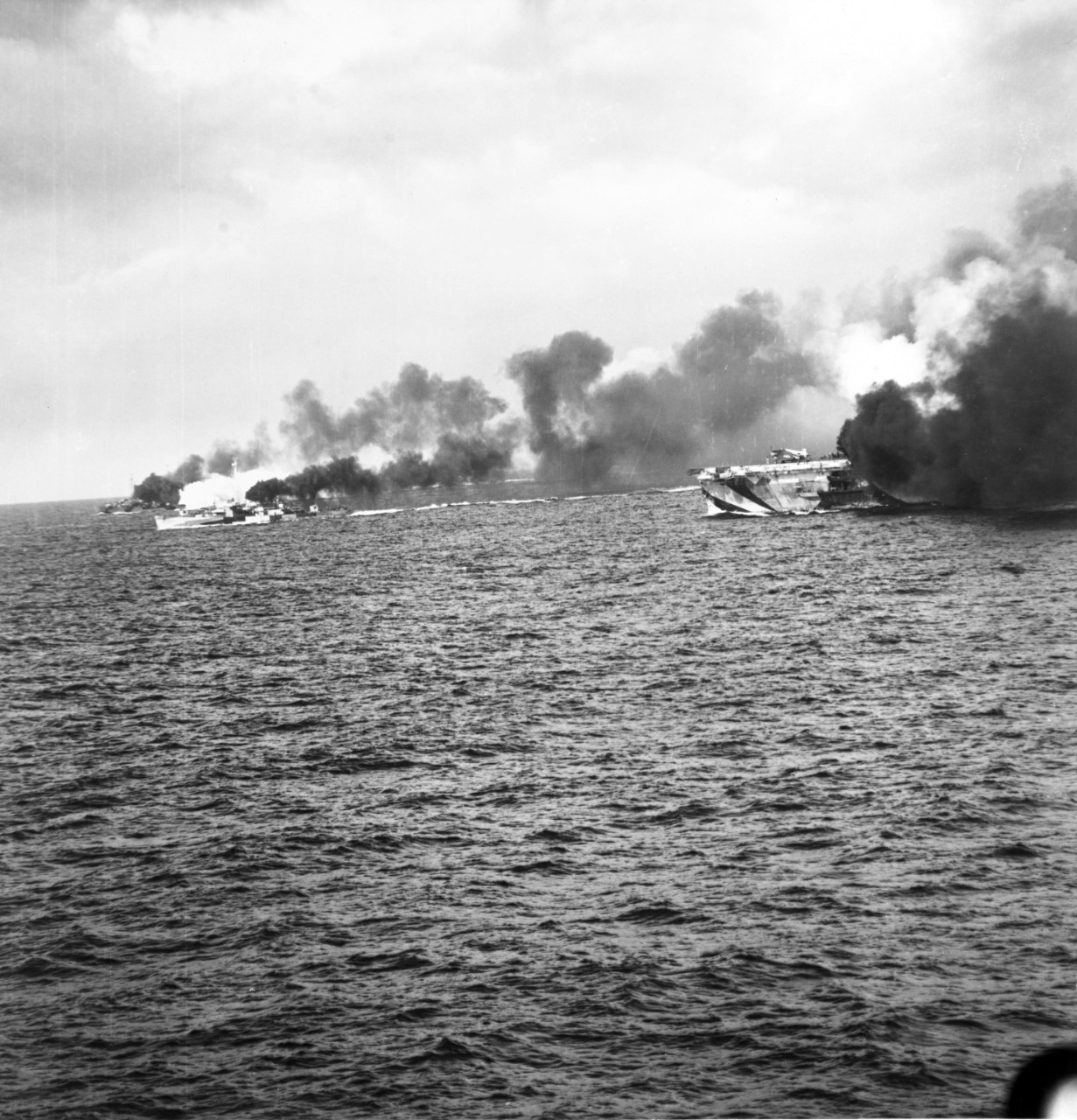
Suddenly, the cruisers on our port side seemed to have leaped ahead and were now on our port beam. I moved to the starboard side once more. Smoke was pouring off of each of the ships, and a thick impenetrable blanket covered all that was off our after port quarter as the wind was blowing in that direction. We covered all the ships in that direction while all the ships to starboard of us covered our rear. It seemed that that destroyer and DE’s had gathered on our starboard side aft while the carriers were mostly to port of us. Therefore all the carriers were closer to the two cruisers on the port beam.
All the carriers were on the same base course roughly altho’ any individual “dodging” on the part of the respective captains may have made some difference. The “cans” and DE’s were roughly to starboard and aft of the carriers, except the one that was aft of us. All of us were laying smoke screens. The ship on our port quarter and beam was really catching hell all this time. The shells were bursting all about her. The one aft of us was also under heavy fire. The one on our port quarter had some particularly “beautiful” displays of colored geysers around her. Red and blue, or green mostly.
About this time it seemed that our escort became more active altho’ how they could become so was a problem as every gun that could reach the Japs was firing and all escorts were laying down smoke, if they had any left. But they did become more active in their movements and maneuvers. One pulled up on our port bow, firing valiantly all the while, then it fell back. Shells were bursting all around it. I was glad when it fell back as it was drawing the enemies fire and we were behind it, thereby the shells started closing on us.
Very roughly about this time it was the first time I could feel a definite hit on us. I was crouching down on our starboard side of the bridge when a faint, but definitely different, shudder ran through the ship. Silent, common agreement passed between us (on the bridge) that “she’s hit,” “got us this time” I fully expected others to follow that first hit. But no, it was not to follow just then that we were to be hit again. It was not till several minutes later that we were to be hit again. That is a hit that could be felt throughout the ship.
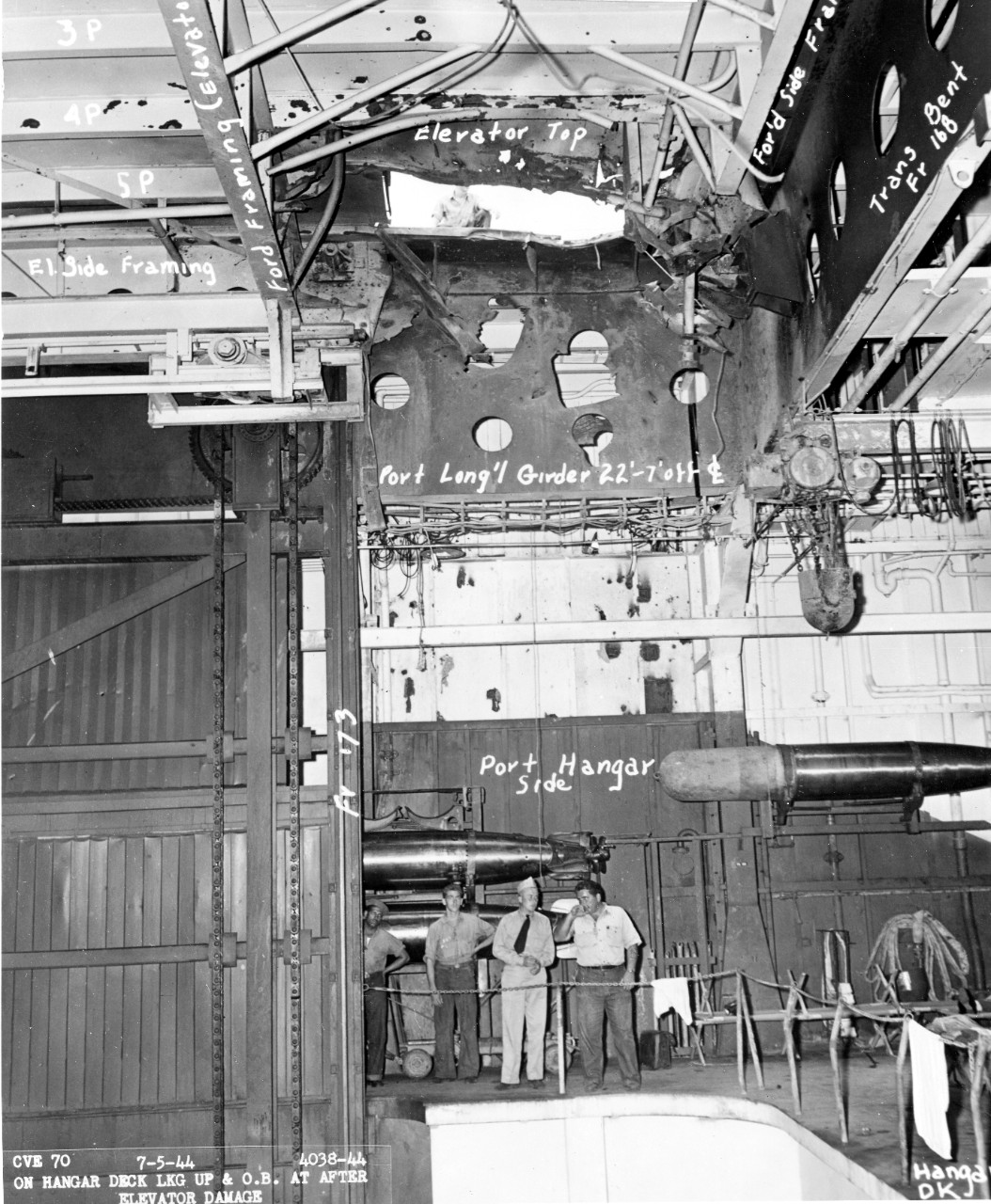
I only felt three of the six hits (perhaps seven) that occurred. The grape-vine told us that the forecastle was hit the first time. I could only see a hole blasted in the extreme forward end of the flight deck, port side (I believe). The hole was about two feet long it seemed, 6 inches across and ran parallel to the catapult. Then the Japs started firing at us again.
Incidentally about this time the order was given to open fire on the Jap cruisers who were now approximately 14,000 yards away and closing. We fired about three salvos from our 5-inch guns aft. Every time it went off I was scared terribly and would jump off the deck about an inch. I thought they were hits on us everytime the five-inch fired, but almost before I hit the deck again I would realize that it was our five-inch firing and not a hit. Then I would look around sheepishly. I suppose it was this firing on our part that drew the Japs fire back on us. But the Jap cruisers didn’t close as fast as they had been. Perhaps it was us maneuvering again, I don’t know.
Anyhow we were hit again. This time a very small hole almost dead center in the flight deck forward, 2 or 3 feet from the forward edge. It didn’t appear to have done much damage. It appeared to be a ricochet from a hit on the forecastle glancing up thru’ the flight deck.
Then the firing seemed to stop on both sides. At least we stopped, the Japs merely had found a more interesting target in the ship off our port quarter. It was just about this time that I went back up on the signal bridge. There in short tense, condensed sentences I found out that the ensign on one of the enemy cruisers could be plainly seen. It was a great big one.
I heard a message that was to be sent to one of the escorts. Message text “Make smoke.” Reply “No smoke.” Boy that sounded bad. If we had no smoke where could we hide or escape to? I imagined we would all be more or less out of smoke soon. After all hadn’t we blackened the atmosphere to a height of several thousand feet and several miles in length and width. Even as I watched the smoke was stopping on the other ships. Our ship still made smoke thanks to our early delay in the beginning to lay the smoke screen, but even this was thinning. Finally it stopped altogether, although black smoke came from our stacks with our full head of steam up.
But I have forgotten a most important part of our maneuvering. When we hit that blessed rain squall we had turned eastward toward the island of Samar and the Straits between it and Leyte (and another island). I expected this maneuver was made, either in an attempt to dash thru’ the straits and perhaps inflict some damage while doing so and then being joined by Halsey’s fleet which (according to past U.S. Naval history) would then appear on the horizon and then save the day, or else it was just as a last hope to frighten off our attackers with shore based planes; or – and this was a hopeless supposition – merely get in close to the beach so that the survivors could make it in for a landing.
I wondered slightly if the inhabitants of Samar would or could be called Samaritans. I hoped so. A short time after those mysterious ships that pulled over the horizon and stayed there were sighted land was also sighted. Well we could reach it then somehow. But we heard at the same time that land was some 35 miles way. At our speed that would mean we would have to undergo shelling for some two hours. Hopeless.
But there was quite a bit of maneuvering amongst our escorts now. One of the destroyers off our port quarter suddenly turned to port and headed directly at the Japanese cruisers off our port beam. He was firing his guns as fast as they could go. No zig-zagging, no smoke, no movements to evade the enemy shellfire. Just a straight course of a David against a Goliath. Shells burst of all sides of that little mite, but he continued until he got to our port quarter, then things must have gotten too hot for him so he turned back and resumed his former station (I believe).
But the cruisers on our port beam were closing in all the time. Ten miles, nine miles, eight miles, seven miles! We were duck soup for them with their eight inch rifles. Perhaps we could turn to starboard and thus evade them. But no the grape-vine said two ships (cruiser and battleship, or two cruisers) on our starboard quarter 9 miles away and closing. No hope then we were trapped. We had to go straight ahead to perhaps escape the closing jaws of that awful pincers. Escape to land dead ahead but then we would be ringed in on three sides and no hope of escape unless planes came from the land. And they were only to have opened up the airfields today. And it was only about 0800 or perhaps as late as 0900 in the morning. Too early for hope there. But land was in sight. Swim to shore to see whom – Japs or friendly natives? If we ever reached land.
Then the cruisers moved still closer. Now they were six miles away. They still seemed to be shooting at that carrier after of us and the one on our port quarter. Or had the one aft of us already dropped back, mortally wounded? When she did we got a slight respite anyhow.
Then we were hit again and I looked at the curve formed by our catapult. It stuck up in the air about two feet at its highest point. Rolled up like a carpet. Iron sheeting a quarter of an inch thick handled in this way seemed almost sacrilegious. It struck at the basis of everything. Was there nothing solid or withstanding in the world? Nothing permanent?
Then a small hole approximately 3 inches in diameter was pointed out to me. Ah well that didn’t cause much damage anyway. It was twenty or thirty feet from the forward edge of the flight deck along the centerline. I found out later this innocent looking hole was caused by a 5-inch(?) shell piercing the flight deck, cutting electrical cables, thru’ a metal door, thru’ the deck, then another bulk head another deck and finally out the side of the ship. Final size of hole 22 by 44 inches. Thru seven metal partitions ranging in size from 3/16ths of an inch to 1/16th inch in the door or hatch.
Then one five inch started again. The cruisers were starting to close again. I thought we were hit and started up again involuntarily lifting my body off the deck and the body of my new friend also. I didn’t have anything under me just that slight bend in the head and shoulders. Yet I lifted my weight and part of the weight of this other man almost completely off the deck.

Then there would be a respite of several minutes where the Japs reloaded. We’d get up again. Then the Japs would start again. We’d crouch again altho’ this time we didn’t go down gradually in a crouch. We both hit the deck again but I won again on the bottom. Then the five inch would fire again and the whole process would start again.
I said prayers very rapidly about this time. The signal chief said things looked pretty black. My friend and I looked at each other and practically said good-bye to each other. But I held a resolution in the back of my mind that I for one was going to get out of this. One time I relaxed completely and said to myself that the Lord would get me out of this, I believed in that completely and absolutely. Never was I so honest in all my life. I practically threw up my hands and said “Lord, it’s up to you now. I believe you will save me. My faith is in you.” And he did.
Then the shells really started coming by us. They seemed to be coming at us with a little flatter trajectory now. We could hear an evil whine as they passed us. An eerie whistle that warned of a passing death. Not one but many of these whistles did we hear. Now we were on the starboard side for sure. Crouching most of the time too. Seemed that too big a target was presented for those piercing shells otherwise, even tho’ hidden by the bridge superstructure. As those shells seemed to get even closer me and another fellow crouched together. Next salvo we’d crouch lower. Next salvo still lower. Finally I won out and was lying down on the deck with my shoulders and head against the bulkhead with him on top of me.
Then I confess that I backslid from that exalted moment. I said Our father – but halfway through realized that I’d said it wrong, so started over. Midway thru’ this prayer my friend sitting on top of me asked me if I prayed any. I said I was praying then. The signal chief overheard us and he crouched down and said he’d done some praying too and he opened up his hand to reveal a rosary. We were pretty close then together. We split up again with another salvo.
Then suddenly for no apparent reason the Jap cruisers on our port beam turned around and headed away from us. They were on our port beam going in directly the opposite direction we were going on, but it seemed that they would never change positions. They stopped firing, but even after what seemed to be a long interval of time they still were on our port beam.
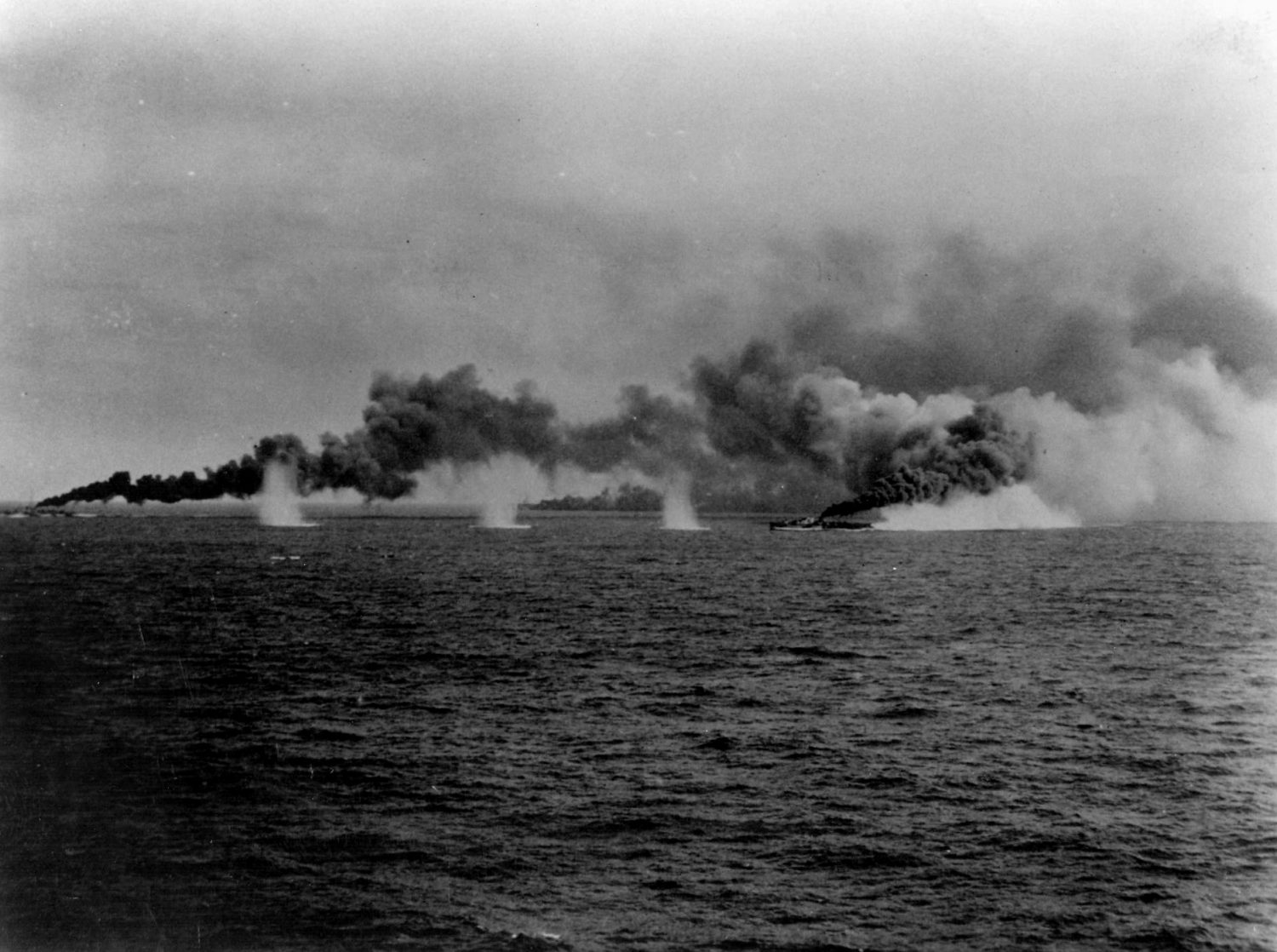
But I have left out a part of this tale. Just as those cruisers were closing in and things looked blackest the grapevine told us all to stand by for a torpedo attack. A Japanese destroyer was making a torpedo run on us. The men on the 40 mm. were told to stand by their guns. And one of our escort headed toward the Japs destroyer. Any how he became discouraged and turned back. Then there was the cry of “Torpedo off our stern.” Some mention of seven torpedo wake’s crossing our wake. Then we were really jittery.
One of the other carriers started firing at something in the water. We followed suit several seconds or minutes later. Then we started seeing things. Our minds were not eased by the fact that planes were now flying around us – even if that were ours – maybe a Jap slipped in, in our confidence. They were torpedo planes, too. Then a fighter appeared and he dropped a gas tank so we were “sure” that we were under torpedo plane attack. Even if it was one of our own fighters. Every whitecap, every wave seemed to be carrying a deadly torpedo at us.
By now things seemed comparatively quiet. The cruisers were now falling back and land was approaching. Now and then a plane would fly by idly from ship to ship. But our nerves were tense. An unfortunate F6F happened to drop his gas tank near another ship and was fired upon by the distraught gunners. Then he flew toward us and we reacted to the excitement by opening fire on him as he flew aft of us. Then he tried to become identified to another ship and as he tried to fly over they opened fire on him. As he dodged this he flew into the range of yet another ship who opened fire. Then he gave up and dived down toward the water. We prayed that he was only escaping fire and would pull out of it. He did. I don’t know how it was that he did, but he did.
Well nothing really serious seemed to be occurring beyond the fact that we were keeping a sharp lookout on everything. The signal chief helped me up on the signal bridge where I happened to be then and wanted me to go down to the galley and get some sandwiches and coffee. So I relaxed and took off the raincoat I had been wearing all this time and forgotten about, and my helmet and another fellow and I went below. Incidentally I’d also delivered a message to the communication officer before this. This was where we could let down after our battle. As we went down on the hangar deck I waved a warm hello to a friend of mine, I was glad to see he was still alive.
Well we went on down to the galley. Everything was locked up with water tight doors, but we finally go in the galley. I filled the pitcher I had with cream and was trying to phenagle some sugar and sandwiches out of one of the mess-cooks. They got us the sugar out by that was all. For there was a sudden burst of twenty mm. gun fire then a terrific explosion or rather the noise of one, as we couldn’t see anything then we suddenly galvanized into action and ran aft to the one open door in the galley. We broke thru’ just as one of the crew was closing the door. Then a wild dash to that open hatch, out over the hangar deck and then a slight pause while I promoted myself a helmet belonging to a lieutenant (J.J.).
Then I dashed up the ladder that led to the flight deck. I started out the hatch but a sudden burst of gun-fire changed my mind for me so I stood just inside the doorway, all the while wondering if the flight deck could repel strafing machine-gun bullets. But the firing soon stopped and I decided to take a chance on running to my battle station, but everything seemed to be over with by then so I went rather slowly then.
When I got back up on the bridge I was told to keep on the look-out for planes. Then the grapevine spotted an enemy plane as it dived on one of the carriers. I was just in time to see it hit the carrier in a final spray of flame as it hit the flight deck and bounced off with all the appearance of a flaming meteor.

Very shortly thereafter a plane was pointed out hovering very high over us slightly forward and to starboard. As I watched him his nose dropped as he started a dive. We opened fire almost immediately. It seemed that he hardly started good on his dive when a noticeable pause took place in his dive. We hit him! Before, he had seemed to be diving toward us or right between us and the carrier ahead of us. But as our shell – or shells – hit him it seemed to change his mind and he started for that forward carrier in earnest. He was still in his dive, but it now became steeper. Our bullets followed him down. But the other carrier wasn’t firing a shot in their own defense. We fired until it seemed we were firing at the other carrier as well as the plane. Then the other carrier opened up. And the plane was hit again. This time the controls were definitely carried away as the plane seemed to wilt suddenly and wobbled on its course. That plane never hit its mark as it crashed into the water near the ship. A vain effort, fruitless as it was desperate.
Another plane was diving now on a different carrier. He came in almost as tho’ he was landing, but he would never walk away from that one if he did hit. And he did. He didn’t seem to blaze as much as the first one did. Fire started.
Then I happened to look away momentarily and when I looked back at that carrier I could see several hoses being played on the fire. But even as I watched an explosion took place. Lots of black smoke belched forth.
Then a change in course was ordered, and we crossed the bow of the stricken carrier. I could see tiny figures dropping over the sides into the water. We seemed to be circling that poor carrier. Then we were warned to keep a look-out for more of these suicidal hell-divers. But that seemed to be the end of them as no more attempted that. There were only a few of our planes circling around helpelessly. One plane flew thru’ the column of smoke that came off the stricken carrier. Then I went on the other side of the bridge to keep a look-out. I sure didn’t want anything to happen to us like that. Then the other carrier had another explosion. Everyone aboard her seemed to be gathered on the forward end of the flight deck, at the opposite end from the explosions. People still seemed to be going over the sides. I watched her some more fascinated. Then she exploded yet another time. Now the smoke was really thick…
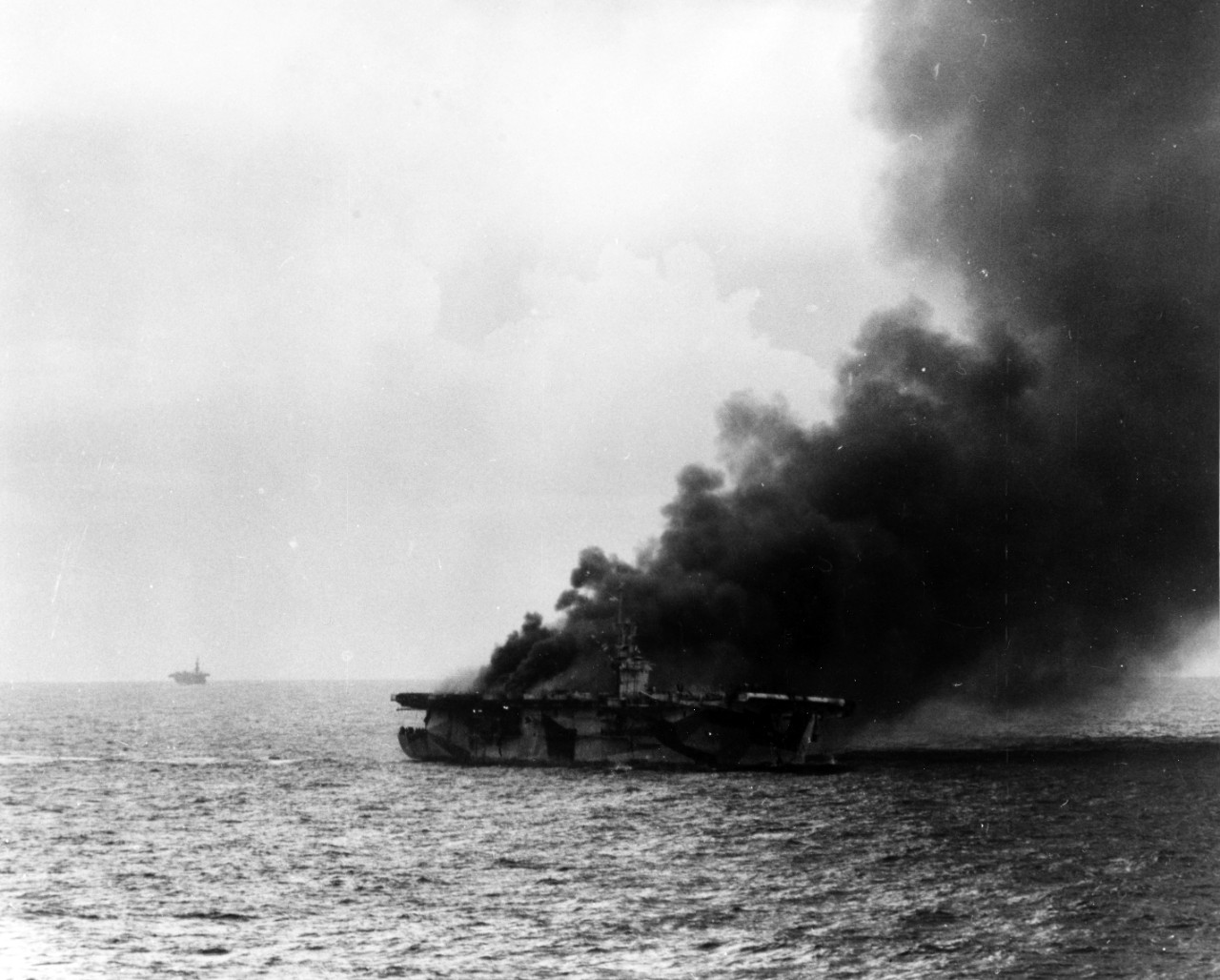
Here the account ends, with the unfortunate crewmembers of the U.S.S. St. Lo abandoning ship at the frantic request of their captain. The archive includes additional handwritten reflections on the engagement and Japanese strategy, including a detailed timeline of major events (replicated below). Of interest here are the censored descriptions of the kamikaze pilots and the disappointing diversion of Halsey’s fleet. One notable excerpt from the six-page essay, which is separate from the aforementioned narrative, reads, “Existence of a special group of s____ pilots had been indicated in previous intelligence info.”
Surface Action Against Enemy
- Events of the morning of 25th of October proceeded along routine lines from midnite until 0645. Sunrise was to be at 0614. The sea was calm with 6 to 8 knots of wind from a north-easterly direction. About three-tenths cumulous clouds were present with widely scattered showers. At 0530, Target Combat Air Patrol of 12 VF had been launched, and at 0607 support groups of 4 VT, Target anti-sub patrol of 2 VT, plus local Combat Air Patrol, and local Anti-sub patrol had been launched. All target missions had departed for target area, patrol plane reported that he was being fired upon by an unidentified group of BB and CA bearing 340 degrees distant about 20 miles. Course was immediately changed to 090 degrees which was close enough to wind to permit launching and still avoid further closing of the contact, and flank speed ordered.
- Subsequent changes of course are shown on the appended track chart and will not be repeated in this narrative. In general, a retirement to the southwest was sought while still avoiding enemy encirclement, in hope that surface support might be obtained from 7th Fleet forces in Leyte Gulf.
- At 0657 commenced launching all available aircraft with orders to attack enemy fleet. Order given to all ships to commence smoking which was promptly obeyed and with grand effect.
- At 0701 an urgent contact report was broadcast on 2096 KO, plain language, voice, giving our posit. & bearing & distance of enemy. Assistance was requested.
- At 0706 enemy was closing with disconcerting rapidity & volume & occurrence of fire was increasing. At this point it did not appear that any of our ships could survive another five minutes of heavy caliber fire being received, and some counter-action was urgently & immediately required. Task Unit was surrounded by ultimate of desperate circumstances. All escorts were ordered to attack enemy with torpedoes. At this time direct view of enemy was obscured by smoke & results of our escorts attack could not be ascertained, but it is believed that, regardless of hits, they succeeded in turning battleships away at least momentarily, and created a diversion of immense value.
- About this time we intercepted a fairly heavy rain squally and while in it change course to right. Combination of rain & smoke made visibility very poor & enemy fire slackened & fell off in accuracy.
- Now it became apparent that enemy had split up and was advancing two heavy cruisers upon our port quarter to encircle our disposition and cut off our retreat. These two heavy cruisers eventually succeeded in advancing about abeam of us and closing range at will. Eight and five inch salvos from their advanced wing were delivered from ranges as low as 10,000 yards and resulted in many straddles and many hits. All available aircraft were diverted to threat and bomb hits were obtained. Our 5” – 38 return fire was reaching these heavy cruisers and some hits were being scored. But notwithstanding our desperate efforts, CA fire was practically continuous and so effective that eventual destruction of all our ships seemed inevitable.
- Numerous colored splashes were seen from dye-loaded projectiles, and splashes were very distinctive. Green, red, and possibly yellow were observed.
- At 0750 FANSHAW BAY was hit forward and again at 0758 also forward.
- At 0800 a group of three destroyers were seen approaching from the southeast. They failed to answer visual challenges and later joined two enemy CA on our port hand as latter began retirement. These DD are there to be advance pickets of enemy northern force altho’ it is possible they were escaping remnants of enemy southern force who succeeded in getting thru’ Avenger Str. In either case it is believed that it was this force that took T.U. 77.4.2 under fire briefly.
- At 0824 four escorts had rejoined after their torp. attack. Last seen of USS Johnson was at time she was making a torpedo attack between enemy cruisers (plane report). The last report of USS Roberts was from a pilot who said she had been badly hit and was sinking. The last report from USS HOEL was that she had a 6 foot hole at water line and was stopping to make repairs.
- At 0824 USS Gambier Bay reported she had been hard hit and had lost use of one engine. She dropped astern and was reported by pilots to have been sunk at very close range by enemy cruisers.
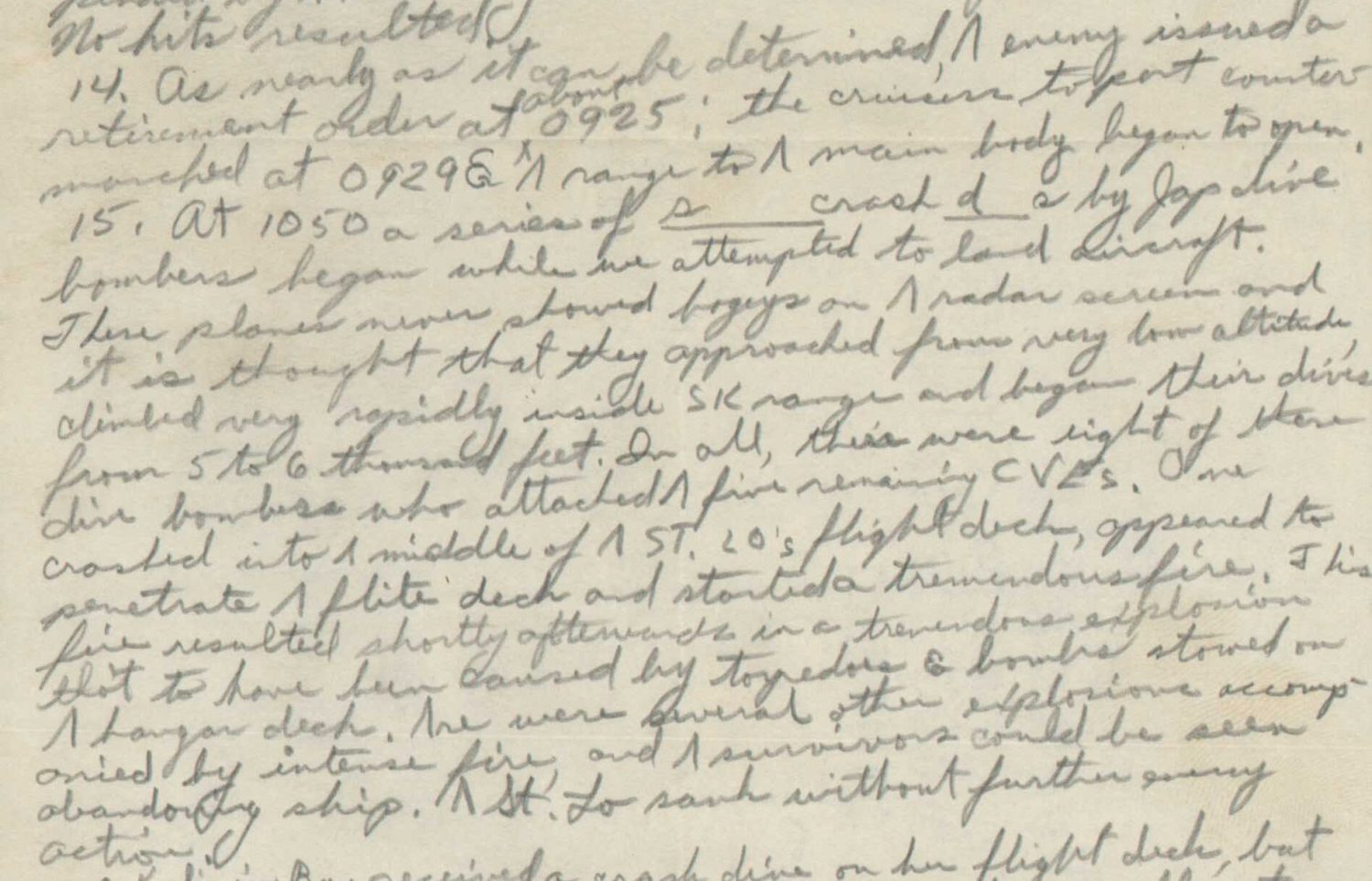
- At 0920 Enemy destroyer began a fast approach from starboard quarter of disposition & at approx. 10,000 yards range fired a large no. of torpedos, turning away immediately in a typical destroyer torpedo attack. Torpedos paralleled our course and were nearly expended by the time they reached the center of our disposition. No hits resulted.
- As nearly as it can be determined, enemy issued a retirement order at about 0925. The cruiser to port countersmoked 0929 & range to main body began to open.
- At 1050 a series of s____ crash d___s by Jap dive bombers began while we attempted to land aircraft. There planes never showed bogeys on radar screen and it is thought that they approached from very low altitude, climbed very rapidly inside SIC range and began their dives from 5 to 6 thousand feet. In all, there were eight of these dive bombers that attacked five remaining CVEs. One crashed into middle of St. Lo’s flight deck, appeared to penetrate flight deck and started a tremendous fire. This fire resulted in shortly afterward a tremendous explosion that had to have been caused by torpedos and bombs stowed on the hangar deck. There were several other explosions accompanied by intense fire, and the survivors could be seen abandoning ship. The St. Lo sank without further enemy action. The Kalinin Bay received a crash dive on the flight deck, but without penetration because the pilot appeared to pull out just before hitting. Two other dives on Kalinin Bay resulted in near misses. The White Plains & Fanshaw Bay each received damage from one near miss by s____ pilots, and the Kitkun Bay suffered two attacks with minor damage.
- Shortly after this, a second strike of TBM’s was launched from Kitkun Bay & White Plain, which were the only two carriers capable of launching TBM’s.
- All escorts were ordered to stand by St. Lo and the area of battle to rescue survivors. The desperate expedient which left the Taks Unit without any screen for the next eight hours was made necessary by the absence of any rescue effort, from other sources. It was not until about 2000 the evening of the 25th when rendezvous was made with Task Unit 77.4.1 that additional screening vessels were obtained, and at this time our ships were already being stalked by an enemy surfaced submarine.
- During the continued retirement to the southeast, air strike groups from both HORNET and WASP who had apparently missed contact with the retreating enemy forces were intercepted by radio and vectored to their objective.
- As we headed towards a rendezvous with Task Unit 77.4.1, straggler aircraft were recovered from this and other units. Until final reports are received from the Leyte fields, an accurate extent of air losses in pilots and planes cannot be made.
Despite being written in shorthand stunted prose and having a handful of grammatical errors, the narrative and strategic assessment reflect the insights of a mature and battle-hardened author. The accompanying map also shows a high level of consideration, if perhaps a lack of cartographic expertise. After surviving the Battle off Samar, the unnamed sailor continued his service aboard the U.S.S. General C. C. Ballou (the Fanshaw Bay underwent significant repairs) until an honorable discharge from Long Beach Hospital in January 1945. From there, it was presumably back to the civilian world and a peacetime life. The fearsome weather, accidents, and withering enemy fire were relegated to memory and the waters of the Pacific, along with the lives of thousands of American and Japanese troops.
Sources/Further Reading
- U.S.S. Fanshaw Bay (CVE-70) (Naval History and Heritage Command).
- The Battle Off Samar: Taffy 3 at Leyte Gulf (Robert Cox)
- “So Beautifully and Bravely Fought“ (U.S. Naval Institute).
- Battle of Leyte Gulf (TIME Magazine)
- The Battle off Samar (American Heritage)
- The Divine Wind (This Day in Aviation)
- The Battle of Samar (Weapons and Warfare)
- Morison, Samuel Eliot. History of United States Naval Operations in World War II, Vol. XII: Leyte, June 1944–January 1945. Boston: Little, Brown and Company, 1958.
- Wukovits, John. For Crew and Country. Macmillan, 29 Jan. 2013.
-
Como, Byron G. The Defenders of Taffy 3: Analysis and Retelling of the Battle of Leyte Gulf. Byron G. Como, 2019.